David Dubrow

Author

  • About Dave
    • Interviews
  • Dave’s Blog
  • Dave’s Fiction
    • The Armageddon Trilogy
      • The Blessed Man and the Witch
      • The Nephilim and the False Prophet
      • The Holy Warrior and the Last Angel
    • Dreadedin Chronicles: The Nameless City
    • Get the Greek: A Chrismukkah Tale
    • Beneath the Ziggurat
    • The Ultimate Guide to Surviving a Zombie Apocalypse
  • Free Stories
    • Hold On
    • How to Fix a Broken World
    • The Armageddon Trilogy Character List and Glossary
  • Social
    • Twitter
    • Facebook
    • Google +
    • Amazon
    • Goodreads

Book Review: Dune: The Butlerian Jihad

August 11, 2014 by David Dubrow Leave a Comment

It gives me no pleasure at all to write a review like this.  I’m intimately familiar with what it takes to write a novel with multiple characters, attempting to describe events that are epic in scope.  And I understand that not every book is going to appeal to every reader.  You can decide that you don’t like a book, but acknowledge that it’s a difference of personal taste, not the book’s quality.  Nevertheless, Dune: The Butlerian Jihad is an objectively bad book that should never have been foisted upon the reading public.

I tried extremely hard to like it.  It promised to describe a very interesting period in the Dune universe: what caused humanity to throw away advanced computer technology in such a way as to refer to it as a jihad?

Well, you can keep asking, because this answer is terrible.  There’s nothing about it that’s worth your time.  Here are some of the low points:

1) The chapter introductions are trite and without insight.  Take this chapter introduction from DTBJ (Dune: The Butlerian Jihad): “When humans created a computer with the ability to collect information and learn from it, they signed the death warrant of mankind.”  Not particularly penetrating, that.  Why bother reading the rest of the book after that?  Contrast it with this chapter intro from Dune: “There is probably no more terrible instant of enlightenment than the one in which you discover your father is a man – with human flesh.”  That tells you something.  You can agree with it or not, but it’s a great insight into what Paul-Muad’Dib thought.  There’s none of that in DTBJ.  The characters and plotting likewise lack depth.

Sandworm: “Ow.”

2) The writing tells you everything without bothering to go through the whole rigmarole of showing you anything.  An example: “He was a serious young man, prone to honesty and with a tendency to see things in black and white….Much admired by his superiors, Xavier had been promoted quickly; equally respected by his soldiers, he was the sort of trusted man they would follow into battle.”  Oh.  Well, great.  I don’t suppose there’s any way the writers could have demonstrated these traits for us in the dialogue or action of the book.  Instead, the reader is beaten over the head with this kind of information.  Clumsy.  Terribly clumsy.  The writers don’t give us the opportunity to judge the characters on their own merits, and instead tell us what to think.

3) The best parts are glossed over, and the story is mundane.  Evil brains-in-a-jar cyborgs called cymeks begin the novel by attacking a planet.  These cymeks have names like Ajax, Agamemnon, and Tlaloc, but don’t act like their namesakes, and there’s little backstory described or told about their origins.  We get ugly little infodumps about them like cat crottes in a litterbox instead.  None of that intricate weaving of history and current action that we’d come to love from Frank Herbert’s work.  The reasons for voluntarily relinquishing one’s own humanity go entirely unexplored here.

DTBJ was a New York Times bestseller, published by Macmillan.  And it’s awful.  Tell me again how self-published books are the scourge of literary quality, and that the more self-published crap gets out there, the less likely it is great, properly-vetted books will be read.  The gatekeepers missed this one.  Big time.

I got 11% in and had to stop reading.  Don’t do what I did and buy it.  Learn from my mistake.  Save yourself.

Facebooktwitterredditpinterestlinkedinmail

Filed Under: bad book, book review, dune, science fiction

Breadhead Friday: Pizza Sauce Recipe

August 8, 2014 by David Dubrow Leave a Comment

Pursuant to the post on making pizza at home, I want to give out my recipe for pizza sauce.  It’s easy, quick, and tasty.  There’s a brightness to it from the red wine vinegar, a little heat from the red pepper flake, and enough spices to give it great flavor, but not overwhelm the toppings and crust.

And the best part is that you don’t have to cook it.  The sauce cooks on the pizza itself.

This recipe is the product of trial and error across dozens of pizzas, and will make enough sauce to cover five (5) average-sized pies.

Ingredients
1 28 oz. can of crushed tomatoes
1 28 oz. can of tomato puree
1 tbsp red wine vinegar
1 and 1/2 tsp garlic powder
1 tbsp basil
1 and 1/2 tsp oregano
1/2 tsp black pepper
A few shakes of red pepper flake
Salt to taste

Mise en place

All you have to do is put the ingredients into a bowl and mix them with a whisk.  Couldn’t be easier.

In the bowl, ready to be whisked

Once you’ve got it mixed together, give it a little taste.  I know it’s not cooked, but it’ll be okay, I promise.  The tomatoes have been steamed as part of the canning process.  If it needs salt, add salt.

All mixed up

If you use the pizza recipe linked at the top of this post, you’ll see that the pizza is baked at a pretty high heat (500 degrees F or higher).  So you don’t need to cook the sauce: it’s a thin layer on the dough that will get cooked as part of the baking process.

The sauce is on the pizza – REPEAT: the sauce is on the pizza

Portion out the sauce into five containers and freeze or refrigerate them as you see fit.  You may want to make this sauce a couple hours before making the pizza to allow the flavors to meld.

The distribution of pepperoni here is reminiscent of the Tunguska Explosion of 1908

There you go.  Now you’ve got one less excuse to go to Pizza Hut.  Not that there’s anything wrong with Pizza Hut.

Facebooktwitterredditpinterestlinkedinmail

Filed Under: breadhead friday, pizza, recipes, sauce, tunguska blast

Got Ligotti?

August 6, 2014 by David Dubrow Leave a Comment

I first encountered Thomas Ligotti in print decades ago, when my younger brother, who had been working at a local bookstore, presented me with a box of coverless paperbacks that had originally been destined for the incinerator.  One of the books included was Ligotti’s Songs of a Dead Dreamer.  On a whim, in-between Eric Van Lustbader’s Nicholas Linnear novels, I cracked it open.

And fell inside.

The stories within were bizarre, disturbing, and like nothing else I’d ever read.  There was a hint of a Lovecraftian style to them, but it appealed to more modern sensibilities.  There were times I had to put it down for a few days not just because what he’d written needed digesting, but because they were so damned creepy.  I can’t describe them here in a way that gives these stories justice, so I highly recommend you go take a look.

This was in the early days of the internet, so there had been no way to learn more about Ligotti and his works, at least for the amount of effort that I had been prepared to expend at the time.  We had telnet that we used to MUD on, and a nascent web, but nothing like we have today.  Other books called, including college textbooks, so I moved on.

The coverless paperback managed to lose itself somewhere between Pennsylvania, Colorado, and Florida as a casualty of my peregrinations across the country, so while Ligotti’s name drifted away from my active consciousness, the effects of his stories stayed with me.

An unfortunate reminder of him came in the form of this blog post on the awesome Lovecraft Ezine.  While it’s great to read that his works have endured such that they’ve possibly been plagiarized, it’s terrible that this has happened.  I haven’t watched the show True Detective, and while I’ve heard good things about it, I probably won’t watch it now.

As it turns out, Ligotti’s not doing as well as one might hope, but he continues to write when he can, and that’s good.  Now that I’m reminded of him, I’ve picked up his The Conspiracy Against the Human Race.  It doesn’t promise to be light reading, which is exactly why I got it.

Read his stuff if you can find it, but be warned: you won’t be the same afterward.

Facebooktwitterredditpinterestlinkedinmail

Filed Under: hbo, horror, ligotti, plagiarism

Charity: Having and Eating Your Cake

August 4, 2014 by David Dubrow Leave a Comment

As part of the process of adopting a child in the United States, we had to attend parenting classes.  These classes taught things like dealing with an emotionally abused or traumatized child, parenting a child from a different culture from you, children with attachment disorder, and several other topics.

For the most part, it was a waste of time.  Much of what was taught wouldn’t apply to our situation.  The agency we went through for our certification did most of their business through foreign adoptions of Ethiopian children.  In fact, we were their first domestic couple.

At the beginning of one class, while we were sitting around waiting for the state-mandated instructor to tell us that a common excuse for why African Americans don’t adopt white babies is because they don’t know how to take care of their hair, one adoptive parent said something extraordinary.  He said, “When I tell my friends that one of the reasons we want to adopt is because we want to do a good deed, they ask me why don’t we just donate the money instead?”  The question had frustrated him, and he didn’t have a good answer for it.

This is a picture of a cake I made in 2009 for illustration purposes.

The nature of the question is instructive in itself, and describes an extremely common mode of thinking: that the value of a good deed, of charity, is measured in large part by how “selfless” the deed is.  As if you’re not supposed to get anything out of performing good works.

That’s ludicrous.  It speaks of a mindset that values intentions over results.

There’s no reason to think that one cannot do a good, even selfless act and still personally profit from it.  The two notions are not mutually exclusive.  Charitable acts don’t have to be their own reward, including the adoption of a child.  One can fulfill the twin desires to become a parent and do a good deed simultaneously, without reservation.

A fed, loved, cared-for child is the result.  The intention is immaterial.

Contrast this, then, with confiscation of property by the government to achieve similar ends: this is not charity, nor is it virtuous.  When the fruits of your labor are taken from you to maintain social programs, it is not charity, because your choice to give has been taken from you at the point of a gun.  If you think this is extreme, try not paying your taxes for a while.  And talk to Wesley Snipes.

Ultimately, we live in a world of results.  Your intentions cannot be measured, nor should they be.  What matters is that you do give, not why.  Anyone seeking to determine the value of your charity by how little you personally gain from it is someone who would prefer to rely on state confiscation rather than good works to achieve virtuous ends.  In a free society, it simply doesn’t work.

Facebooktwitterredditpinterestlinkedinmail

Filed Under: adoption, ethics, parenthood

Breadhead Friday: The Agony and Ecstasy of Raisin Bread

August 1, 2014 by David Dubrow Leave a Comment

My earliest memories of raisin bread involve tearing off the top crust to eat the icing and throwing out the rest of the slice.  My brothers did the same, so my dad stopped buying it.  It just wasn’t very good.

This focaccia-style raisin bread from Peter Reinhart is the complete opposite of that.  It’s extraordinary.  It’s the apotheosis of raisin bread.  It’s what raisin bread is supposed to be.

I won’t duplicate his recipe here; you can get it from Artisan Breads Every Day or from his Craftsy class, which is worth purchasing if you want to learn how to make delicious bread and pizza at home.  The main difference between the savory focaccia recipe and the raisin bread recipe is that you have to use a little more water in the raisin bread dough to plump up the dried fruit.

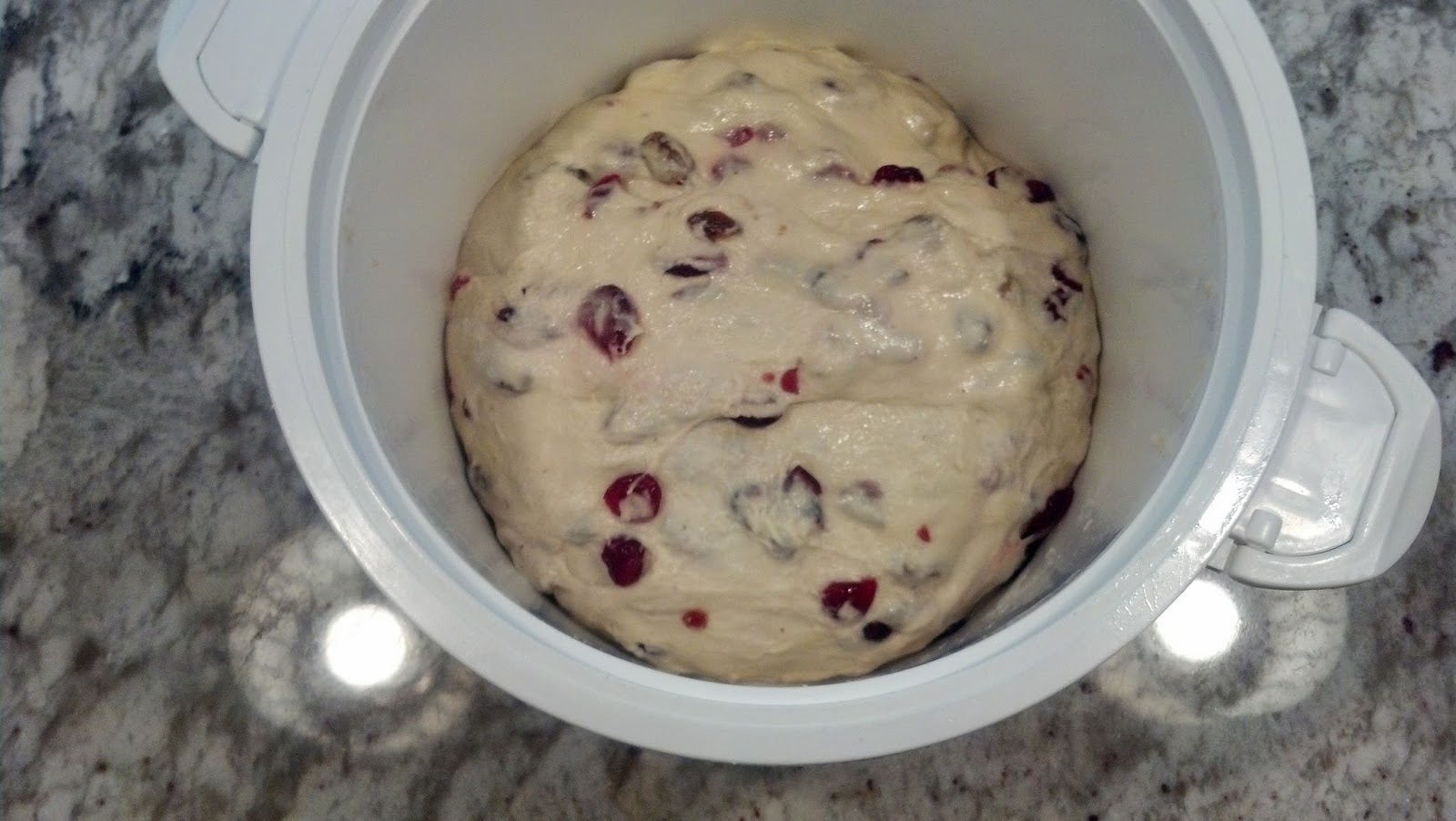
For these loaves, I used a combination of dried cranberries, raisins, and dried cherries.

Dough ready for overnight rise

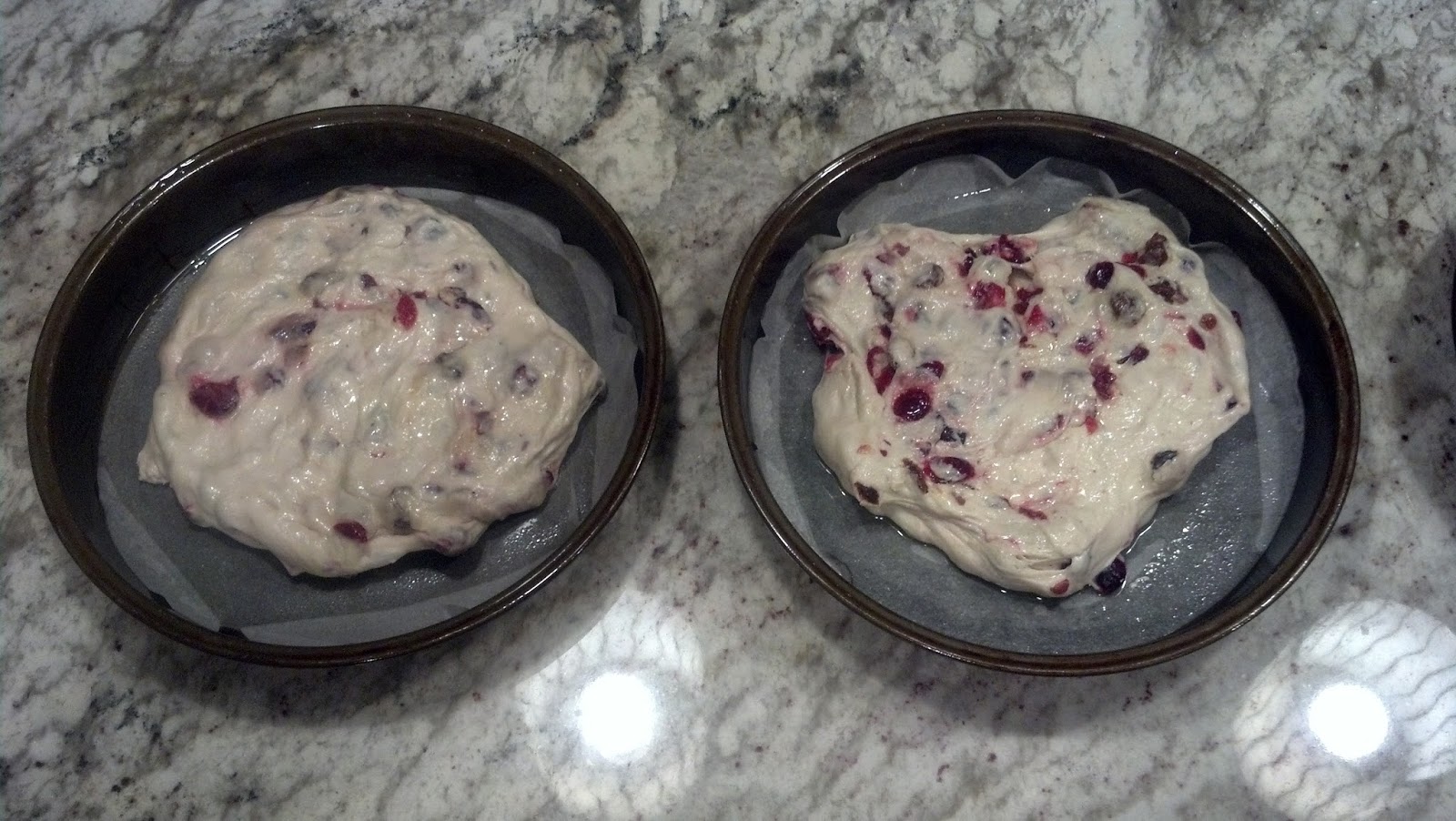
The recipe makes three 9-inch loaves (or discs) of raisin bread, and requires cake pans, parchment paper rounds, and a little oil to drizzle on top of the dough to help in shaping.  I used a combination of vegetable and canola oil.

Portioned, cold dough
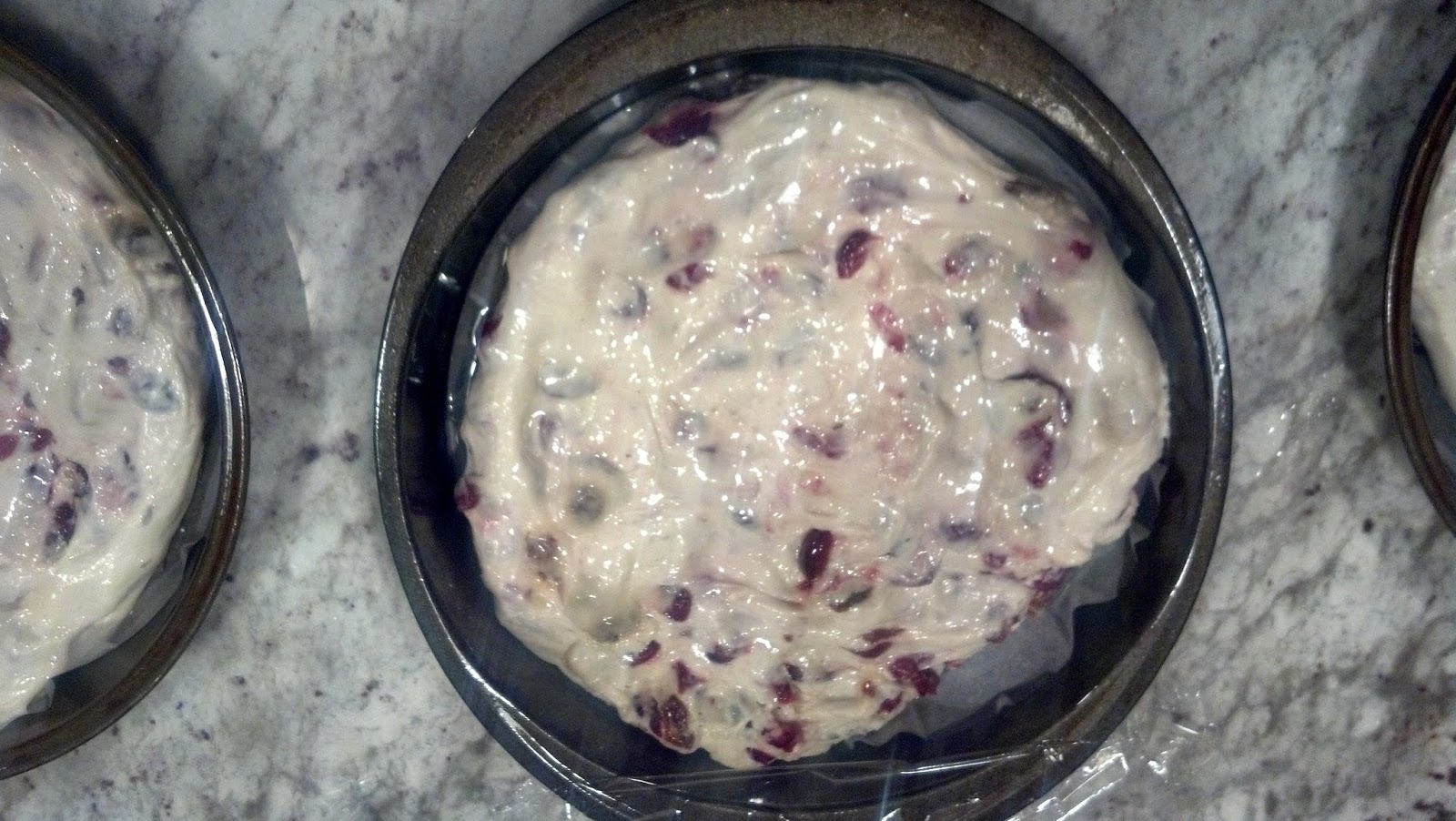
The shaping in the pan consists of little more than dimpling it: evenly pressing it with your fingertips so that it fills the entire pan.  When it starts to resist, you leave it in a warm place to relax for several minutes.
After the first dimpling
After the third and final dimpling; ready for a rise
Then the loaves get baked in a hot oven for around 10-15 minutes, depending.  You don’t need the pizza stone for this bread.
Baked and cooling – note the bubbles
For icing, I just whisked together confectioner’s sugar and whole milk and drizzled it on the cooled loaves.  I like a stiff sort of icing, so I only put in a few drops of milk.  For a looser, more gooey icing, put in more milk.
Iced and ready to eat
You could add vanilla or almond extract to the icing if you wanted, or even put in some orange zest or Grand Marnier.  Or substitute coconut milk for the whole milk.  Experiment, go wild.  
The obligatory close-up

The sweetness of the icing works very well against the tartness of the dried fruit.  The texture is light, with a pleasant crunch and moistness.  Even if you don’t like raisin bread, you’ll like this.  
Facebooktwitterredditpinterestlinkedinmail

Filed Under: bread, breadhead friday, focaccia, i'm not gonna buy it if you kids won't eat it, icing, raisin bread, recipes

Adoption Stories: The Beginning

July 31, 2014 by David Dubrow Leave a Comment

I wrote a piece for Clancy Tucker’s blog on domestic adoption in the state of Colorado.  It outlines, in very broad strokes, the process of adopting a baby boy, like we did.

There’s a great deal more to it, and as always, God is in the details.  (Or, depending on one’s mood, the Devil is in the details.)  Future pieces will describe some of these experiences more specifically.

Unless you’ve done it, unless you’ve been there, it’s not what you think.

Take a look at it on Clancy’s blog.

Facebooktwitterredditpinterestlinkedinmail

Filed Under: adoption, parenthood, son

  • « Previous Page
  • 1
  • …
  • 55
  • 56
  • 57
  • 58
  • 59
  • …
  • 63
  • Next Page »

"It began to drizzle rain and he turned on the windshield wipers; they made a great clatter like two idiots clapping in church." --Flannery O'Connor, Wise Blood

"Squop chicken? I never get enough to eat when I eat squop chicken. I told you that when we sat down. You gotta give me that. I told you when we sat down, I said frankly I said this is not my idea of a meal, squop chicken. I'm a big eater." --John O'Hara, BUtterfield 8

I saw the 1977 cartoon The Hobbit as a little boy, and it kindled a love of heroic fantasy that has never left me. Orson Bean's passing is terrible news. Rest in peace.

Obviously, these young people have been poorly served by their parents, but the honest search for practical information should be lauded, not contemned.

You shouldn't look at or use Twitter, and this story is another perfect example. There's so much that's wrong here that it would take a battalion of clergy, philosophers, and psychologists to fully map it out, let alone treat the issue.

This is the advertising copy for Ilana Glazer's stand-up comedy special The Planet Is Burning: "Ilana Glazer‘s debut standup special is trés lol, and turns out - she one funny b. Check out Ilana’s thoughts on partnership, being a successful stoner adult, Nazis, Diva Cups, and more. Hold on to your nuts cuz this hour proves how useless the patriarchy is. For Christ’s sake, The Planet Is Burning, and it’s time a short, queer, hairy New York Jew screams it in your face!" This is written to make you want to watch it.

In the midst of reading books about modern farming, the 6,000 year history of bread, and ancient grains, I found this just-published piece by farmer and scholar Victor Davis Hanson: Remembering the Farming Way.

"I then confront the decreasing power of the movement in order to demonstrate the need for increased theorizations of the reflexive capacities of institutionalized power structures to sustain oppositional education social movements." Yes. Of course.

You should definitely check out Atomickristin's sci-fi story Women in Fridges.

As it turns out, there may yet be some kind of personal cost for attempting to incite a social media mob into violence against a teenage boy you don't know, but decided to hate anyway because reasons.

One of the biggest problems with internet content is that the vast majority of sites don't pay their writers, and it shows in the lack of quality writing. It's hard to find decent writers, and harder to scrape up the cash to pay them. This piece is a shining example of the problem of free content: it's worth what you pay for.

If you're interested in understanding our current cultural insanity, the best primer available is Douglas Murray's The Madness of Crowds. Thoughtful, entertaining, and incisive.

More laws are dumb. More law enforcement is dumb. The only proper response to violence is overwhelming violence. End the assault. There's a rising anti-semitism problem in New York because Jews who act like victims are being victimized by predators. None of these attacks are random. Carry a weapon and practice deploying it under duress. Be alert and aware. I don't understand why the women Tiffany Harris attacked didn't flatten her face into the pavement, but once word gets around that the consequences of violence are grave, the violence will lessen.

When are you assholes going to understand that this stupidity doesn't work any longer? Nobody gives much of a damn if you think we're sexist because we don't want to see a movie you think we should see. It only makes us dislike you that much more, and you started out being an unlikable asshole. Find a new way to shame normal people.

The movie Terms of Endearment still holds up more than 35 years later, and if you're looking for a tearjerker, this is your jam. One element that didn't get a lot of mention is, at the end, when Flap, with a shrug, decides that his mother-in-law will become the mother of his children once Emma dies. He abandons them, and nothing is made of it. This always troubled me.

You need to read this story the next time you feel the urge to complain. And if you need a shot of admiration for another family's courage, check this out.

Progressive political activist and children's author J.K. Rowling finds herself on the wrong side of a mob she helped to create. The Woke Sandwich she's been trying to force-feed others since she earned enough f-you money doesn't taste as good as it looks when she's obliged to take a bite.

I need you to check out The Kohen Chronicles and pray for this family. Their 5-year-old son has cancer.

Currently, the movie Star Wars: The Rise of Skywalker stands at 55% at Rotten Tomatoes. Don't forget that these are the same reviewers who not only adored the absolutely execrable The Last Jedi, but insisted that you were a MAGA hat-wearing incel white supremacist manbaby for not loving The Last Jedi. So either The Rise of Skywalker is an objectively bad film, or it simply wasn't woke enough to earn plaudits from our movie-reviewing moral and intellectual betters.

It's easy to hate the older pop bands like Genesis for their popularity, but they were capable of genius, and it shows in No Son of Mine.

If you want to know which identity group has more clout, read this story of the Zola ads on the Hallmark Channel.

Rest in peace, René Auberjonois. I remember you from Benson as a kid. As an adult, I remember you as Janos Audron in the Legacy of Kain video game series. You made every role you were in a classic.

Elf on a Shelf Follies, Part 2:
8-year-old: I wrote the elf a note! I hope he writes back.
Me: What did you write?
8yo: I asked if he has any friends.
Me: What if he says it's none of your business?
8yo: *eyes grow dark and glittering* Then I'll...touch him.
Me: Ah. Mutually assured destruction, then.

Elf on a Shelf Follies, Part 1: My 8-year-old got an Elf on the Shelf the other day. The book it came with tells a story in doggerel about this elf's purpose, which is to spy on the kid and report his doings to Santa Claus, who would then determine if the kid is worthy for Christmas presents this year. The book also said for the kid not to touch him, or the magic would fade, and for the family to give the elf a name. I wanted to name him Stasi. I was outvoted.

Actor Billy Dee Williams calls himself a man or a woman, depending on whim; his character Lando Calrissian is "pansexual," and his writer implies that he'd become intimate with anyone or anything, including, one presumes, a dog, a toaster, or a baby. J.J. Abrams is very concerned about LGBTQ representation in the Star Wars universe. This is Hollywood. This is Star Wars. This is what's important to the people in charge of your cinematic entertainment. Are you not entertained?

The funniest thing on the internet today is the number of people angry over an exercise bike commercial. Public outrage is always funny. Always.

One of the biggest mistakes the United States has ever made since WWII was recruiting for clandestine and federal law enforcement organizations at Ivy League schools. The best talent pools were/are available from local law enforcement and military veterans, with their maturity and, most importantly, field experience. We've been reaping the costs of these terrible decisions for decades, culminating in a hopelessly politicized, sub-competent FBI and CIA.

Watching Fauda seasons 1 and 2 again in preparation for season 3 to be broadcast, one hopes, in early 2020. Here's my back-of-the-matchbook review of season 2.

Every day I try to be grateful for what I have, even in the face of the petty frustrations and troubles that pockmark a day spent outside of one's living room, binge-watching Netflix. We live lives of ease in 21st century America, making it enormously difficult to do anything but take one's countless blessings for granted. Holidays like the just-passed Thanksgiving are helpful reminders. There's a reason why people call the attitude of a thankful heart practicing gratitude, not just feeling grateful. You have to practice it. You have to remind yourself of what you have. It's the work of a lifetime.

Held Back: A Recent Conversation.
8-year-old: Oh, and Jamie was there, too. He was in my first grade class two years ago.
Me: Wasn't he held back a year?
8yo: Yeah. It's because he kept going to the bathroom with the door open.
Me: No way!
8yo: And girls saw.
Me: That's not right. They're not going to hold a kid back a whole year over that.
8yo: Well, that's what he told me.
Me: Sounds fishy.
8yo: I believe him.
~fin~

It's right and good to push a raft of politically correct social justice policies on everything else under the sun, but when social justice invades Hollywood, that's just a bridge too far, says Terry Gilliam. Sorry, Terry: you helped make this sandwich. EAT IT.

Rob Henderson's piece on luxury beliefs will have you nodding your head over and over again...unless you subscribe to these luxury beliefs, in which case you'll get mad.

I've made the Saturday bread from Flour Water Salt Yeast so often that I've memorized the recipe. It never disappoints. Never. The same recipe works well for pizza, too.

Liberty doesn't mean the freedom to do anything you want. The true definition of liberty is the ability to choose the good. Anything less is libertinism.

Archives

My Social Media Links

  • Twitter
  • Facebook
  • Google +

Author Links

  • Amazon Author Page
  • Goodreads

Copyright © 2026 · Author Pro Theme on Genesis Framework · WordPress · Log in