David Dubrow

Author

  • About Dave
    • Interviews
  • Dave’s Blog
  • Dave’s Fiction
    • The Armageddon Trilogy
      • The Blessed Man and the Witch
      • The Nephilim and the False Prophet
      • The Holy Warrior and the Last Angel
    • Dreadedin Chronicles: The Nameless City
    • Get the Greek: A Chrismukkah Tale
    • Beneath the Ziggurat
    • The Ultimate Guide to Surviving a Zombie Apocalypse
  • Free Stories
    • Hold On
    • How to Fix a Broken World
    • The Armageddon Trilogy Character List and Glossary
  • Social
    • Twitter
    • Facebook
    • Google +
    • Amazon
    • Goodreads

Book Review: Graham Masterton’s Ghost Music

December 1, 2014 by David Dubrow Leave a Comment

I’ve been a huge fan of Graham Masterton since the early 1990’s.  Two of his novels, Night Warriors and Flesh and Blood, occupy prized spots on my dresser, so I can see them every day.  Like most writers who’ve had long, successful careers, some of his books have been great, some good, and some not so good.

Unfortunately, Ghost Music wasn’t so good.  This is why I didn’t enjoy it:

  • Graham’s American Problem: There’s a persistent problem with the novels Masterton sets in the U.S.: they’re self-evidently written by someone unfamiliar with American idiom, customs, and culture.  He’s typically got very snappy, witty dialogue, which is great, but occasionally English expressions like “Who’s X when he’s at home?” pop in when Americans speak to each other, and it takes you out of the story and reminds you who’s writing it.  His attempts to immerse the reader in American culture simply fail most of the time, because when he’s not trying too hard, he’s not trying enough.  I just wish he’d stop it.  American horror fans will buy books set in Poland and the U.K. if he writes them.  This problem was very much evident in Ghost Music.
  • Stupid Protagonist: Another major criticism of the novel is that the protagonist was an absolute idiot from start to finish.  While I understand that authors who work through traditional publishers often don’t get to choose the titles of their novels, it makes for a frustrating reading experience to read about a man who’s obviously seeing ghosts everywhere but has no idea that he’s seeing ghosts.  He’s even screwing one who has the uncanny ability to shatter glass with her screams of delight at climax.  It’s only near the end that he figures out that the people who appear and disappear, are dead one day and alive the next, are actually…wait for it…ghosts.  The protagonist also makes a number of very strange decisions, all of which make no sense but are vital to move the plot forward.  This is sloppy writing.  It shows a lack of respect for the reader.
  • Bad Bad Guys: There was needless brutality in the way certain people met their end: a boy has his eyes glued shut as part of the torture he endures before dying, and a young girl is literally sewed to a mattress that is later sunk into the sea (we’ll ignore how the latter can possibly be done for the purposes of storytelling).  The impetus for this brutality involves a hastily thrown-together denouement with illegal organ harvesting in the Third World and a mafia-like antagonist.

Across the board not one of his best, but I did finish it.  Two stars.

Final note: When he’s on his game, Graham Masterton is extraordinary.  I’ll take him over Stephen King any day. Don’t take this one review as indicative of his entire oeuvre.


Facebooktwitterredditpinterestlinkedinmail

Filed Under: bad book, book review, ghosts, graham masterton, horror, review

Kathleen Hale the Stalker: 4 Things to Consider

October 29, 2014 by David Dubrow 1 Comment

Kathleen Hale is a writer who, after having gotten a bad review on her book, stalked the reviewer online, in person, and on the phone.  Hale wrote about her experiences in The Guardian, and the story has elicited a great deal of comment in both writer and reviewer circles.  As usual, I’m a bit late to the party, but I figured I’d make my thoughts known anyway.

  1. There’s an expression that I love when it comes to commentary on situations like these: moral preening.  Or, if you prefer, burnishing your moral bona-fides.  In short, you should get no points for taking the moral stand that’s self-evidently right, even if many people have taken the opposite position.  There’s no bravery in pointing out an obviously wrong thing and saying, “Hey, you shouldn’t do that.”  With that in mind, it’s clear that Hale was completely batshit crazy and shouldn’t have stalked the reviewer.  She shouldn’t be trusted with sharp objects, she’s an entitled lunatic, etc. etc.  We know that, so let’s move on.
  2. This is an interesting piece, if only because it hits the most overwrought high points and completely forgets how unbelievably small the respective author and reviewer pools truly are compared to the population of actual readers.  The vast majority of readers don’t give a shit outside of the drama Hale’s story has created, which is itself interesting reading.  If all the book bloggers/reviewers went on strike, people would still buy and read books.  Even indie books.  Note also terms like “systematic devaluation of female voices” in the actual piece and comments from readers that include “it all seems to me to be part and parcel of a trend toward silencing women”.  This from an opinion piece that does more than just reference a woman writer who stalked a woman reviewer.  If female voices are being devalued, some of the blame must fall upon women, right?  The expression about one’s only tool being a hammer and every problem resembling a nail comes to mind.  If everything’s about women’s issues, nothing’s about women’s issues.  This isn’t about women’s issues.
  3. I care about reviews: most beginning writers do.  Reviews affect business.  Obviously, I only want honest reviews from people who read the book (no moral preening here).  If the book’s great, tell me so.  Tell everyone how great it is so they buy it, too.  However, I ache for the time when none of it will matter so much to me.  It will require a great deal of work to get there, so I just put my head down and write.  When it comes to bad reviews (anything less than 3 stars is a bad review, and even a 3-star review isn’t good), they hurt, but you suck it up and move on.  If the reviewer has something pithy to say, you go back and see if the criticism is valid.  Improve where you can and move on.  One thing, though: I reserve the right to hate you a little because you didn’t like my book.  Just a little.  I won’t act on it.  But it’ll be this thing between us.  And you might have forgotten it, but for me, it’s always there.  For some writers, the hate is bigger.  For some unhinged writers, there’s a need to act on that hate, hence Hale.  
  4. Goodreads is where the dastardly attack on Hale’s good name was perpetrated.  I dislike Goodreads.  Most authors I speak to feel the same way.  It’s tailor-made for the passive-aggressive set, with its context-free rating system that doesn’t require that you’ve read anything further than the blurb to use.  Many Goodreads reviewers love to write long, vicious attack screeds about the books and authors they hate, and these reviewers have gained reader followings for those screeds.  Self-important internet book-tyrants stake out fiefs on Goodreads, and woe to the fool who makes the mistake of expressing a different opinion.  Luckily, Goodreads isn’t representative of the reading population.  Hopefully it isn’t representative of humanity in general.  Like every other form of social media, it’s high school.  It’s small.  It’s not the real world.  But writers have to acknowledge it.  

All the successful writers I respect say the same thing: ignore the reviews.  Write.  Improve.  Market.  Repeat.  It’s what I intend to do.

Right after I check my Amazon writer page to see if anyone else has reviewed my books yet.

Facebooktwitterredditpinterestlinkedinmail

Filed Under: book review, goodreads, inside baseball, kathleen hale, review

Book Review: The Blue Tent Sky

October 20, 2014 by David Dubrow Leave a Comment

I can’t remember where I found the link to Brian Aitken’s Indiegogo site, but I do recall that once I read it, I had to contribute.  His story required it.

The book blurb says, “In 2010 Brian Aitken was sentenced to seven years in prison for possessing firearms he legally owned. He lost everything, including custody of his son, for a crime he did not commit. After spending four months behind bars, Governor Chris Christie demanded his release. This is his story.”

For anyone interested in personal freedom, firearms laws, individual rights, or an inside look at an extremely arbitrary and capricious legal system, this book is a must-read.  The early part of Brian’s story is immediately recognizable: an acrimonious divorce followed by parental alienation, but it soon spirals into a horribly Kafkaesque nightmare culminating in a seven-year prison sentence for the crime of moving one’s lawfully-owned firearms from one residence to another.

While gripping, the book isn’t without its flaws.  Some grammatical mistakes, odd phrasing, and disjointed story-telling occasionally mar the narrative; it needed one last pass with an editor before it went to print.  In addition, there’s a ham-handed marketing effort to make Brian’s story a left vs. right issue, which doesn’t fit.  The American left doesn’t like guns and wants to outlaw private ownership of them, yes, but this case was about the typical unthinking gun-grabbing that’s part and parcel of northeastern liberalism, not a true political effort.  An overzealous prosecutor and disgustingly biased judge wanted to make an example of Brian not because he was a conservative, but because he dared to own guns in their state.

Brian had been gored by two bulls: America’s awful family court system (which treats all fathers like disposable potential abusers) and New Jersey’s contradictory, even senseless firearms laws.  I can’t imagine how terrible it must be to have one’s own son ripped away like Brian’s, but to be sentenced to prison on top of that for not having done anything illegal is unthinkable.  Despite this, Brian treated the subject matter with admirable grace.

The story hits its nadir with Brian’s chilling account of county jail, followed by prison.  As appalling as the experience was, the injustice of it made it even worse, no doubt, and I needed a Silkwood shower after reading it.

Whether or not you can ever see yourself in Brian’s shoes, what happened to him was a terrible injustice.  Buy his book.  Read it.  And stay out of New Jersey if you legally own a firearm.

Four out of five stars.

Facebooktwitterredditpinterestlinkedinmail

Filed Under: blue tent sky, book review, brian aitken, firearms laws, guns, new jersey

Book Review: Dune: The Butlerian Jihad

August 11, 2014 by David Dubrow Leave a Comment

It gives me no pleasure at all to write a review like this.  I’m intimately familiar with what it takes to write a novel with multiple characters, attempting to describe events that are epic in scope.  And I understand that not every book is going to appeal to every reader.  You can decide that you don’t like a book, but acknowledge that it’s a difference of personal taste, not the book’s quality.  Nevertheless, Dune: The Butlerian Jihad is an objectively bad book that should never have been foisted upon the reading public.

I tried extremely hard to like it.  It promised to describe a very interesting period in the Dune universe: what caused humanity to throw away advanced computer technology in such a way as to refer to it as a jihad?

Well, you can keep asking, because this answer is terrible.  There’s nothing about it that’s worth your time.  Here are some of the low points:

1) The chapter introductions are trite and without insight.  Take this chapter introduction from DTBJ (Dune: The Butlerian Jihad): “When humans created a computer with the ability to collect information and learn from it, they signed the death warrant of mankind.”  Not particularly penetrating, that.  Why bother reading the rest of the book after that?  Contrast it with this chapter intro from Dune: “There is probably no more terrible instant of enlightenment than the one in which you discover your father is a man – with human flesh.”  That tells you something.  You can agree with it or not, but it’s a great insight into what Paul-Muad’Dib thought.  There’s none of that in DTBJ.  The characters and plotting likewise lack depth.

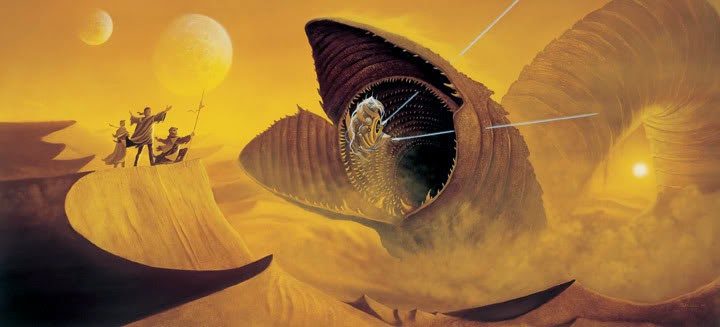
Sandworm: “Ow.”

2) The writing tells you everything without bothering to go through the whole rigmarole of showing you anything.  An example: “He was a serious young man, prone to honesty and with a tendency to see things in black and white….Much admired by his superiors, Xavier had been promoted quickly; equally respected by his soldiers, he was the sort of trusted man they would follow into battle.”  Oh.  Well, great.  I don’t suppose there’s any way the writers could have demonstrated these traits for us in the dialogue or action of the book.  Instead, the reader is beaten over the head with this kind of information.  Clumsy.  Terribly clumsy.  The writers don’t give us the opportunity to judge the characters on their own merits, and instead tell us what to think.

3) The best parts are glossed over, and the story is mundane.  Evil brains-in-a-jar cyborgs called cymeks begin the novel by attacking a planet.  These cymeks have names like Ajax, Agamemnon, and Tlaloc, but don’t act like their namesakes, and there’s little backstory described or told about their origins.  We get ugly little infodumps about them like cat crottes in a litterbox instead.  None of that intricate weaving of history and current action that we’d come to love from Frank Herbert’s work.  The reasons for voluntarily relinquishing one’s own humanity go entirely unexplored here.

DTBJ was a New York Times bestseller, published by Macmillan.  And it’s awful.  Tell me again how self-published books are the scourge of literary quality, and that the more self-published crap gets out there, the less likely it is great, properly-vetted books will be read.  The gatekeepers missed this one.  Big time.

I got 11% in and had to stop reading.  Don’t do what I did and buy it.  Learn from my mistake.  Save yourself.

Facebooktwitterredditpinterestlinkedinmail

Filed Under: bad book, book review, dune, science fiction

Book Review: Antediluvian by R.M. Huffman

July 16, 2014 by David Dubrow 2 Comments

R.M. Huffman’s research, writing, and attention to detail take familiar fantasy elements and transform them into something extraordinary in this pre-Flood adventure novel, one that is definitely worth your time.  It’s a fascinating story about the world-that-was described so sparingly in the Book of Genesis, where morning mists covered the Earth in lieu of rain, Watcher angels gave into lust to lay with human women, and dragon-like sauropods were used as beasts of burden.  The offspring of these human-angel couplings, the giant Nephilim, are major figures here, as are the more recognizable Biblical characters of Methuselah, Lamech, and Noah.

The narrative begins on a small scale, as the descendants of Adam, living in post-Fall Eden, are brought into cultural (and sometimes physical) conflict with the sons of Cain, living in the massive, decadent city of Enoch.  It explodes from there into a larger story rife with horrific murders, shocking betrayals, and even a tragic seduction.  Noah, the protagonist, is forced by events to move away from the more pedestrian role of farmer and architect into freedom fighter and prophet.  
The lavish descriptions, speculative world-building, and vivid battle scenes make this a world you can look forward to visiting again in the upcoming sequel.  Four stars.

R.M. Huffman can be found on his website: http://antediluvianworld.com.

Facebooktwitterredditpinterestlinkedinmail

Filed Under: angels, antediluvian, book review, fantasy, huffman, nephilim, noah, review, sauropods

  • « Previous Page
  • 1
  • 2

"It began to drizzle rain and he turned on the windshield wipers; they made a great clatter like two idiots clapping in church." --Flannery O'Connor, Wise Blood

"Squop chicken? I never get enough to eat when I eat squop chicken. I told you that when we sat down. You gotta give me that. I told you when we sat down, I said frankly I said this is not my idea of a meal, squop chicken. I'm a big eater." --John O'Hara, BUtterfield 8

I saw the 1977 cartoon The Hobbit as a little boy, and it kindled a love of heroic fantasy that has never left me. Orson Bean's passing is terrible news. Rest in peace.

Obviously, these young people have been poorly served by their parents, but the honest search for practical information should be lauded, not contemned.

You shouldn't look at or use Twitter, and this story is another perfect example. There's so much that's wrong here that it would take a battalion of clergy, philosophers, and psychologists to fully map it out, let alone treat the issue.

This is the advertising copy for Ilana Glazer's stand-up comedy special The Planet Is Burning: "Ilana Glazer‘s debut standup special is trés lol, and turns out - she one funny b. Check out Ilana’s thoughts on partnership, being a successful stoner adult, Nazis, Diva Cups, and more. Hold on to your nuts cuz this hour proves how useless the patriarchy is. For Christ’s sake, The Planet Is Burning, and it’s time a short, queer, hairy New York Jew screams it in your face!" This is written to make you want to watch it.

In the midst of reading books about modern farming, the 6,000 year history of bread, and ancient grains, I found this just-published piece by farmer and scholar Victor Davis Hanson: Remembering the Farming Way.

"I then confront the decreasing power of the movement in order to demonstrate the need for increased theorizations of the reflexive capacities of institutionalized power structures to sustain oppositional education social movements." Yes. Of course.

You should definitely check out Atomickristin's sci-fi story Women in Fridges.

As it turns out, there may yet be some kind of personal cost for attempting to incite a social media mob into violence against a teenage boy you don't know, but decided to hate anyway because reasons.

One of the biggest problems with internet content is that the vast majority of sites don't pay their writers, and it shows in the lack of quality writing. It's hard to find decent writers, and harder to scrape up the cash to pay them. This piece is a shining example of the problem of free content: it's worth what you pay for.

If you're interested in understanding our current cultural insanity, the best primer available is Douglas Murray's The Madness of Crowds. Thoughtful, entertaining, and incisive.

More laws are dumb. More law enforcement is dumb. The only proper response to violence is overwhelming violence. End the assault. There's a rising anti-semitism problem in New York because Jews who act like victims are being victimized by predators. None of these attacks are random. Carry a weapon and practice deploying it under duress. Be alert and aware. I don't understand why the women Tiffany Harris attacked didn't flatten her face into the pavement, but once word gets around that the consequences of violence are grave, the violence will lessen.

When are you assholes going to understand that this stupidity doesn't work any longer? Nobody gives much of a damn if you think we're sexist because we don't want to see a movie you think we should see. It only makes us dislike you that much more, and you started out being an unlikable asshole. Find a new way to shame normal people.

The movie Terms of Endearment still holds up more than 35 years later, and if you're looking for a tearjerker, this is your jam. One element that didn't get a lot of mention is, at the end, when Flap, with a shrug, decides that his mother-in-law will become the mother of his children once Emma dies. He abandons them, and nothing is made of it. This always troubled me.

You need to read this story the next time you feel the urge to complain. And if you need a shot of admiration for another family's courage, check this out.

Progressive political activist and children's author J.K. Rowling finds herself on the wrong side of a mob she helped to create. The Woke Sandwich she's been trying to force-feed others since she earned enough f-you money doesn't taste as good as it looks when she's obliged to take a bite.

I need you to check out The Kohen Chronicles and pray for this family. Their 5-year-old son has cancer.

Currently, the movie Star Wars: The Rise of Skywalker stands at 55% at Rotten Tomatoes. Don't forget that these are the same reviewers who not only adored the absolutely execrable The Last Jedi, but insisted that you were a MAGA hat-wearing incel white supremacist manbaby for not loving The Last Jedi. So either The Rise of Skywalker is an objectively bad film, or it simply wasn't woke enough to earn plaudits from our movie-reviewing moral and intellectual betters.

It's easy to hate the older pop bands like Genesis for their popularity, but they were capable of genius, and it shows in No Son of Mine.

If you want to know which identity group has more clout, read this story of the Zola ads on the Hallmark Channel.

Rest in peace, René Auberjonois. I remember you from Benson as a kid. As an adult, I remember you as Janos Audron in the Legacy of Kain video game series. You made every role you were in a classic.

Elf on a Shelf Follies, Part 2:
8-year-old: I wrote the elf a note! I hope he writes back.
Me: What did you write?
8yo: I asked if he has any friends.
Me: What if he says it's none of your business?
8yo: *eyes grow dark and glittering* Then I'll...touch him.
Me: Ah. Mutually assured destruction, then.

Elf on a Shelf Follies, Part 1: My 8-year-old got an Elf on the Shelf the other day. The book it came with tells a story in doggerel about this elf's purpose, which is to spy on the kid and report his doings to Santa Claus, who would then determine if the kid is worthy for Christmas presents this year. The book also said for the kid not to touch him, or the magic would fade, and for the family to give the elf a name. I wanted to name him Stasi. I was outvoted.

Actor Billy Dee Williams calls himself a man or a woman, depending on whim; his character Lando Calrissian is "pansexual," and his writer implies that he'd become intimate with anyone or anything, including, one presumes, a dog, a toaster, or a baby. J.J. Abrams is very concerned about LGBTQ representation in the Star Wars universe. This is Hollywood. This is Star Wars. This is what's important to the people in charge of your cinematic entertainment. Are you not entertained?

The funniest thing on the internet today is the number of people angry over an exercise bike commercial. Public outrage is always funny. Always.

One of the biggest mistakes the United States has ever made since WWII was recruiting for clandestine and federal law enforcement organizations at Ivy League schools. The best talent pools were/are available from local law enforcement and military veterans, with their maturity and, most importantly, field experience. We've been reaping the costs of these terrible decisions for decades, culminating in a hopelessly politicized, sub-competent FBI and CIA.

Watching Fauda seasons 1 and 2 again in preparation for season 3 to be broadcast, one hopes, in early 2020. Here's my back-of-the-matchbook review of season 2.

Every day I try to be grateful for what I have, even in the face of the petty frustrations and troubles that pockmark a day spent outside of one's living room, binge-watching Netflix. We live lives of ease in 21st century America, making it enormously difficult to do anything but take one's countless blessings for granted. Holidays like the just-passed Thanksgiving are helpful reminders. There's a reason why people call the attitude of a thankful heart practicing gratitude, not just feeling grateful. You have to practice it. You have to remind yourself of what you have. It's the work of a lifetime.

Held Back: A Recent Conversation.
8-year-old: Oh, and Jamie was there, too. He was in my first grade class two years ago.
Me: Wasn't he held back a year?
8yo: Yeah. It's because he kept going to the bathroom with the door open.
Me: No way!
8yo: And girls saw.
Me: That's not right. They're not going to hold a kid back a whole year over that.
8yo: Well, that's what he told me.
Me: Sounds fishy.
8yo: I believe him.
~fin~

It's right and good to push a raft of politically correct social justice policies on everything else under the sun, but when social justice invades Hollywood, that's just a bridge too far, says Terry Gilliam. Sorry, Terry: you helped make this sandwich. EAT IT.

Rob Henderson's piece on luxury beliefs will have you nodding your head over and over again...unless you subscribe to these luxury beliefs, in which case you'll get mad.

I've made the Saturday bread from Flour Water Salt Yeast so often that I've memorized the recipe. It never disappoints. Never. The same recipe works well for pizza, too.

Liberty doesn't mean the freedom to do anything you want. The true definition of liberty is the ability to choose the good. Anything less is libertinism.

Archives

My Social Media Links

  • Twitter
  • Facebook
  • Google +

Author Links

  • Amazon Author Page
  • Goodreads

Copyright © 2026 · Author Pro Theme on Genesis Framework · WordPress · Log in