David Dubrow

Author

  • About Dave
    • Interviews
  • Dave’s Blog
  • Dave’s Fiction
    • The Armageddon Trilogy
      • The Blessed Man and the Witch
      • The Nephilim and the False Prophet
      • The Holy Warrior and the Last Angel
    • Dreadedin Chronicles: The Nameless City
    • Get the Greek: A Chrismukkah Tale
    • Beneath the Ziggurat
    • The Ultimate Guide to Surviving a Zombie Apocalypse
  • Free Stories
    • Hold On
    • How to Fix a Broken World
    • The Armageddon Trilogy Character List and Glossary
  • Social
    • Twitter
    • Facebook
    • Google +
    • Amazon
    • Goodreads

Confessions of a Former (?) D&D Geek

September 29, 2014 by David Dubrow Leave a Comment

Our culture has changed significantly since I paid attention to it, which was quite some time ago.  I suspect that fantasy role-playing games (RPGs) aren’t considered quite as nerdy now as they were in my time, but I could be wrong.  With the mainstream popularity of video games, it seems that the pen-and-paper games should also enjoy a little more cachet.

Without them, I would not be a writer.  Games like D&D, Call of Cthulhu, Villains and Vigilantes, etc. were quite formative in my social life and helped build my mental landscape.  Without use, your imagination shrinks.  The stories we told during those games were really quite extraordinary.

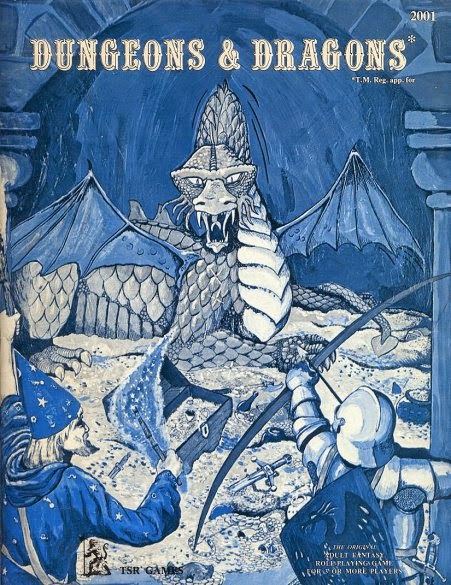
It was on a rainy day in 1980 that my older brother introduced us to Dungeons and Dragons, the blue box version.  Though fairly young at the time, I was utterly captivated.  We played, of course, The Keep on the Borderlands module (we called them “modules” because that was what was printed on the box; more properly, they’d be called stories, or scenarios).  Those early games didn’t last long for reasons I no longer recall, but the game had lit a fire in me.
A couple years later, we unearthed those old D&D rulebooks and played again, mostly just my younger and I, with me as the Dungeon Master (also called “referee” or “game master”).  Then, during a trip to a local bookstore, I found the Dungeon Master’s Guide and Player’s Manual for Advanced Dungeons and Dragons.  Advanced!  Wait: you could be both an Elf and a Magic-User?  That was when things got really fun.

In high school, I joined the D&D club (called the Simulations Club) on a whim, which was one of the best decisions of my life: it helped me get out of my shell a little and introduced me to people who are still friends today.  One afternoon a week, we’d spend a couple hours after school killing monsters, sneaking into castles, and other such things.  All on paper.

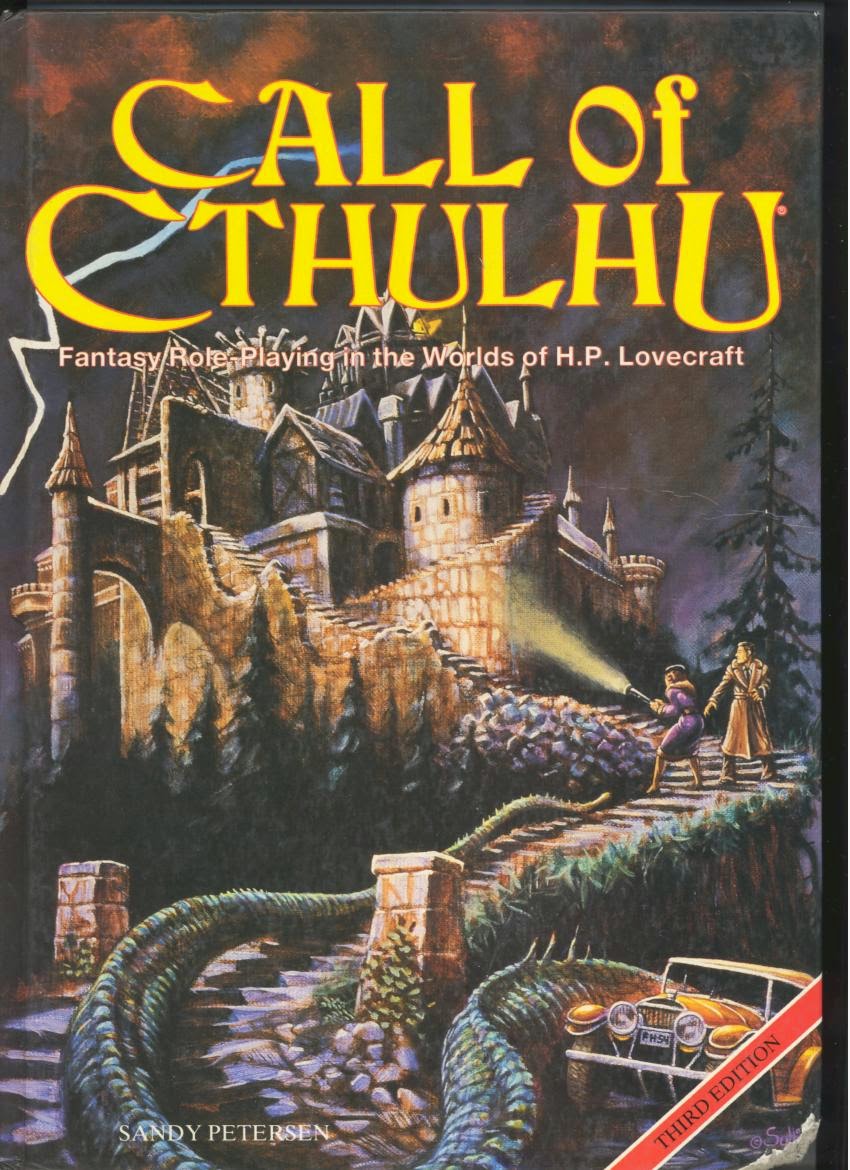
From there, I found the game Call of Cthulhu: rather than play Lord of the Rings-style adventures, you took on the role of a 1920’s paranormal investigator dealing with H.P. Lovecraft’s Cthulhu mythos.  It was neat, but what really made it come alive for our gaming group was the Dreamlands expansion, where you could descend the seven hundred steps to the Gate of Deeper Slumber, and from there emerge into a fantasy world both surreal and horrifying.  Zoogs and horned Men of Leng, cat-inhabited Ulthar and Kuranes’ Celephais, moonbeasts and magicians.

By this time, I was typically the game master, the one who ran the Sunday night games: it was a role I enjoyed more than playing.  The games got even more interesting when I acquired both the Stormbringer and Hawkmoon role-playing game sets, which had the same core rules as Call of Cthulhu (all of them were published by Chaosium).  Rather than a limited universe of Earth and the Dreamlands, the players went further afield to Granbretan and the Young Kingdoms, and from there to the multiverse.
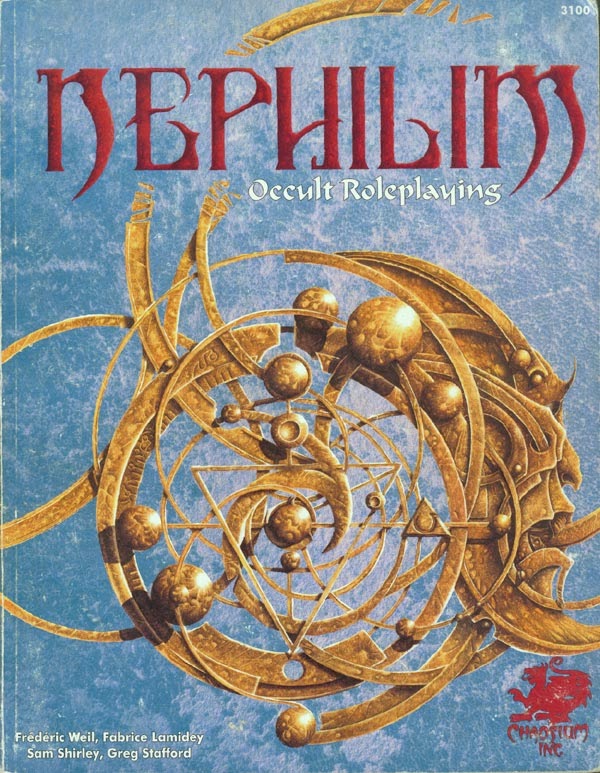
And then something new came around: Nephilim.  Also a Chaosium game, it had a similar rule set, but the setting was so different, so intriguing, that it couldn’t be folded into the long-running game.  We started anew.  The basic premise of Nephilim was that the players took on the role of semi-immortal spirits who possessed human beings throughout history, acquiring magical power and influence.  It was a world of secret societies, of changing human events to suit inhuman schemes.  Just creating a character took the whole day.

Eventually, as marriages, careers, children, and other elements of daily life took over, the game broke up.  For a while I resurrected it online with some of the old players, using a telnet client, but it didn’t have the same oomph as gathering around a kitchen or rec room table, playing face-to-face.

There’s a lot here I didn’t mention in detail: the Friday night D&D sessions, forays into Vampire: The Masquerade, Villains and Vigilantes, the Illuminati and Family Business card games, Dune, Axis and Allies, and poker.  All of them are worthy of pages of description.  Except for poker, which is fairly pedestrian, even when you get into variations like Follow the Wild Queen Chicago Recall.

Sometimes, I miss it.  But I’m too busy now telling my stories my way to collaborate the way these old games required.

Without it, though, without D&D and Call of Cthulhu, I wouldn’t be here, doing what I’m doing now.  There was true magic in those old games, and the spell they laid on me will last my entire life.  The rule books are still in boxes somewhere, waiting to be opened and enjoyed again.

Facebooktwitterredditpinterestlinkedinmail

Filed Under: call of cthulhu, chaosium, dungeons and dragons, elric, fantasy, hawkmoon, lovecraft, role-playing games, rpg, science fiction, stormbringer

Book Review: Dune: The Butlerian Jihad

August 11, 2014 by David Dubrow Leave a Comment

It gives me no pleasure at all to write a review like this.  I’m intimately familiar with what it takes to write a novel with multiple characters, attempting to describe events that are epic in scope.  And I understand that not every book is going to appeal to every reader.  You can decide that you don’t like a book, but acknowledge that it’s a difference of personal taste, not the book’s quality.  Nevertheless, Dune: The Butlerian Jihad is an objectively bad book that should never have been foisted upon the reading public.

I tried extremely hard to like it.  It promised to describe a very interesting period in the Dune universe: what caused humanity to throw away advanced computer technology in such a way as to refer to it as a jihad?

Well, you can keep asking, because this answer is terrible.  There’s nothing about it that’s worth your time.  Here are some of the low points:

1) The chapter introductions are trite and without insight.  Take this chapter introduction from DTBJ (Dune: The Butlerian Jihad): “When humans created a computer with the ability to collect information and learn from it, they signed the death warrant of mankind.”  Not particularly penetrating, that.  Why bother reading the rest of the book after that?  Contrast it with this chapter intro from Dune: “There is probably no more terrible instant of enlightenment than the one in which you discover your father is a man – with human flesh.”  That tells you something.  You can agree with it or not, but it’s a great insight into what Paul-Muad’Dib thought.  There’s none of that in DTBJ.  The characters and plotting likewise lack depth.

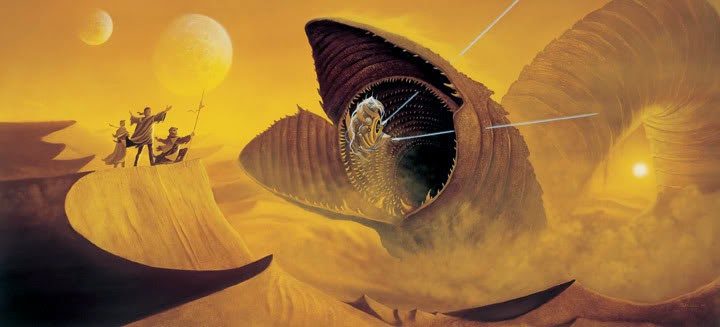
Sandworm: “Ow.”

2) The writing tells you everything without bothering to go through the whole rigmarole of showing you anything.  An example: “He was a serious young man, prone to honesty and with a tendency to see things in black and white….Much admired by his superiors, Xavier had been promoted quickly; equally respected by his soldiers, he was the sort of trusted man they would follow into battle.”  Oh.  Well, great.  I don’t suppose there’s any way the writers could have demonstrated these traits for us in the dialogue or action of the book.  Instead, the reader is beaten over the head with this kind of information.  Clumsy.  Terribly clumsy.  The writers don’t give us the opportunity to judge the characters on their own merits, and instead tell us what to think.

3) The best parts are glossed over, and the story is mundane.  Evil brains-in-a-jar cyborgs called cymeks begin the novel by attacking a planet.  These cymeks have names like Ajax, Agamemnon, and Tlaloc, but don’t act like their namesakes, and there’s little backstory described or told about their origins.  We get ugly little infodumps about them like cat crottes in a litterbox instead.  None of that intricate weaving of history and current action that we’d come to love from Frank Herbert’s work.  The reasons for voluntarily relinquishing one’s own humanity go entirely unexplored here.

DTBJ was a New York Times bestseller, published by Macmillan.  And it’s awful.  Tell me again how self-published books are the scourge of literary quality, and that the more self-published crap gets out there, the less likely it is great, properly-vetted books will be read.  The gatekeepers missed this one.  Big time.

I got 11% in and had to stop reading.  Don’t do what I did and buy it.  Learn from my mistake.  Save yourself.

Facebooktwitterredditpinterestlinkedinmail

Filed Under: bad book, book review, dune, science fiction

“Get out of my MIND!”

June 30, 2014 by David Dubrow Leave a Comment

I’ve been rereading Frank Herbert’s Dune.  I’ve read it several times since my teens, but this is the first reread in a decade.  Now that I’m reading with both eyes open: one to be entertained and one to see what Herbert did and learn from it, I’m finding brand new things to like and dislike about the novel.  Despite some flaws, it’s still captivating.

Like many, I came to Dune through David Lynch’s movie.  Dune purists hated it.  The critics thought it was laughable.  It was overwrought, overacted, and, in the Alan Smithee extended version, way overlong.

I loved it.  I still do.

It’s colored my reading the book.  I can’t help but read Paul’s dialogue in Kyle MacLachlan’s too-precise voice.  Linda Hunt has become the Shadout Mapes for me.  The late, great Robert Jordan was unfortunately miscast as Duncan Idaho, a small role in the film but a massive one in the books.  Can’t forget Sting as Feyd-Rautha (in later years, when my friends and I played Avalon Hill’s awesome Dune strategy board game, we’d always refer to him as “Lovely Feyd” in a breathy Kenneth McMillan voice).

If I’d read the book first, I’d no doubt have a different opinion of both it and the film.  Better or worse, I don’t know.  The book was definitely better: a typical claim.

Contrast that with Mario Puzo’s The Godfather.  Same situation: I’d seen the movie first, then read the book.  The difference here is that the movie was much, much better.  It was tighter, more cohesive, more entertaining.  The book had some weird subplots that included a mostly superfluous Johnny Fontaine and a young woman who needed an operation on her private parts, neither of which were connected.  Characters came in and out with little rhyme or reason.  It was a fun read, but didn’t do much for me.

Our current media culture tells us that the book is no longer enough.  If it’s popular, it needs a movie.  Or a television series.  Or a movie sequel.  I don’t attach a value judgment to this: it is what it is.  Before I became a dad, I went to see a lot of movies, and I still like to watch them when I have the time.

What the media culture creates is a crossover effect for the book.  The Dune phenomenon I mentioned earlier can’t be avoided.  David Lynch’s bizarre vision of Frank Herbert’s universe has, in part, become my vision of it.  I know I’m not alone in this.  What’s seen can’t be unseen.  Lynch has put himself into my copy of the book.

The late Puzo and equally late Herbert aside, do the authors of these books know what’s been done to them in the minds of their readers?  Translating them to a new medium doesn’t change the words printed on the page, but it does alter our perception of them.  They no longer exist in discrete vacuums; one format informs and alters the other.

Facebooktwitterredditpinterestlinkedinmail

Filed Under: dune, frank herbert, mario puzo, movies, science fiction, the book was better, the godfather, the movie was better

  • « Previous Page
  • 1
  • 2

"It began to drizzle rain and he turned on the windshield wipers; they made a great clatter like two idiots clapping in church." --Flannery O'Connor, Wise Blood

"Squop chicken? I never get enough to eat when I eat squop chicken. I told you that when we sat down. You gotta give me that. I told you when we sat down, I said frankly I said this is not my idea of a meal, squop chicken. I'm a big eater." --John O'Hara, BUtterfield 8

I saw the 1977 cartoon The Hobbit as a little boy, and it kindled a love of heroic fantasy that has never left me. Orson Bean's passing is terrible news. Rest in peace.

Obviously, these young people have been poorly served by their parents, but the honest search for practical information should be lauded, not contemned.

You shouldn't look at or use Twitter, and this story is another perfect example. There's so much that's wrong here that it would take a battalion of clergy, philosophers, and psychologists to fully map it out, let alone treat the issue.

This is the advertising copy for Ilana Glazer's stand-up comedy special The Planet Is Burning: "Ilana Glazer‘s debut standup special is trés lol, and turns out - she one funny b. Check out Ilana’s thoughts on partnership, being a successful stoner adult, Nazis, Diva Cups, and more. Hold on to your nuts cuz this hour proves how useless the patriarchy is. For Christ’s sake, The Planet Is Burning, and it’s time a short, queer, hairy New York Jew screams it in your face!" This is written to make you want to watch it.

In the midst of reading books about modern farming, the 6,000 year history of bread, and ancient grains, I found this just-published piece by farmer and scholar Victor Davis Hanson: Remembering the Farming Way.

"I then confront the decreasing power of the movement in order to demonstrate the need for increased theorizations of the reflexive capacities of institutionalized power structures to sustain oppositional education social movements." Yes. Of course.

You should definitely check out Atomickristin's sci-fi story Women in Fridges.

As it turns out, there may yet be some kind of personal cost for attempting to incite a social media mob into violence against a teenage boy you don't know, but decided to hate anyway because reasons.

One of the biggest problems with internet content is that the vast majority of sites don't pay their writers, and it shows in the lack of quality writing. It's hard to find decent writers, and harder to scrape up the cash to pay them. This piece is a shining example of the problem of free content: it's worth what you pay for.

If you're interested in understanding our current cultural insanity, the best primer available is Douglas Murray's The Madness of Crowds. Thoughtful, entertaining, and incisive.

More laws are dumb. More law enforcement is dumb. The only proper response to violence is overwhelming violence. End the assault. There's a rising anti-semitism problem in New York because Jews who act like victims are being victimized by predators. None of these attacks are random. Carry a weapon and practice deploying it under duress. Be alert and aware. I don't understand why the women Tiffany Harris attacked didn't flatten her face into the pavement, but once word gets around that the consequences of violence are grave, the violence will lessen.

When are you assholes going to understand that this stupidity doesn't work any longer? Nobody gives much of a damn if you think we're sexist because we don't want to see a movie you think we should see. It only makes us dislike you that much more, and you started out being an unlikable asshole. Find a new way to shame normal people.

The movie Terms of Endearment still holds up more than 35 years later, and if you're looking for a tearjerker, this is your jam. One element that didn't get a lot of mention is, at the end, when Flap, with a shrug, decides that his mother-in-law will become the mother of his children once Emma dies. He abandons them, and nothing is made of it. This always troubled me.

You need to read this story the next time you feel the urge to complain. And if you need a shot of admiration for another family's courage, check this out.

Progressive political activist and children's author J.K. Rowling finds herself on the wrong side of a mob she helped to create. The Woke Sandwich she's been trying to force-feed others since she earned enough f-you money doesn't taste as good as it looks when she's obliged to take a bite.

I need you to check out The Kohen Chronicles and pray for this family. Their 5-year-old son has cancer.

Currently, the movie Star Wars: The Rise of Skywalker stands at 55% at Rotten Tomatoes. Don't forget that these are the same reviewers who not only adored the absolutely execrable The Last Jedi, but insisted that you were a MAGA hat-wearing incel white supremacist manbaby for not loving The Last Jedi. So either The Rise of Skywalker is an objectively bad film, or it simply wasn't woke enough to earn plaudits from our movie-reviewing moral and intellectual betters.

It's easy to hate the older pop bands like Genesis for their popularity, but they were capable of genius, and it shows in No Son of Mine.

If you want to know which identity group has more clout, read this story of the Zola ads on the Hallmark Channel.

Rest in peace, René Auberjonois. I remember you from Benson as a kid. As an adult, I remember you as Janos Audron in the Legacy of Kain video game series. You made every role you were in a classic.

Elf on a Shelf Follies, Part 2:
8-year-old: I wrote the elf a note! I hope he writes back.
Me: What did you write?
8yo: I asked if he has any friends.
Me: What if he says it's none of your business?
8yo: *eyes grow dark and glittering* Then I'll...touch him.
Me: Ah. Mutually assured destruction, then.

Elf on a Shelf Follies, Part 1: My 8-year-old got an Elf on the Shelf the other day. The book it came with tells a story in doggerel about this elf's purpose, which is to spy on the kid and report his doings to Santa Claus, who would then determine if the kid is worthy for Christmas presents this year. The book also said for the kid not to touch him, or the magic would fade, and for the family to give the elf a name. I wanted to name him Stasi. I was outvoted.

Actor Billy Dee Williams calls himself a man or a woman, depending on whim; his character Lando Calrissian is "pansexual," and his writer implies that he'd become intimate with anyone or anything, including, one presumes, a dog, a toaster, or a baby. J.J. Abrams is very concerned about LGBTQ representation in the Star Wars universe. This is Hollywood. This is Star Wars. This is what's important to the people in charge of your cinematic entertainment. Are you not entertained?

The funniest thing on the internet today is the number of people angry over an exercise bike commercial. Public outrage is always funny. Always.

One of the biggest mistakes the United States has ever made since WWII was recruiting for clandestine and federal law enforcement organizations at Ivy League schools. The best talent pools were/are available from local law enforcement and military veterans, with their maturity and, most importantly, field experience. We've been reaping the costs of these terrible decisions for decades, culminating in a hopelessly politicized, sub-competent FBI and CIA.

Watching Fauda seasons 1 and 2 again in preparation for season 3 to be broadcast, one hopes, in early 2020. Here's my back-of-the-matchbook review of season 2.

Every day I try to be grateful for what I have, even in the face of the petty frustrations and troubles that pockmark a day spent outside of one's living room, binge-watching Netflix. We live lives of ease in 21st century America, making it enormously difficult to do anything but take one's countless blessings for granted. Holidays like the just-passed Thanksgiving are helpful reminders. There's a reason why people call the attitude of a thankful heart practicing gratitude, not just feeling grateful. You have to practice it. You have to remind yourself of what you have. It's the work of a lifetime.

Held Back: A Recent Conversation.
8-year-old: Oh, and Jamie was there, too. He was in my first grade class two years ago.
Me: Wasn't he held back a year?
8yo: Yeah. It's because he kept going to the bathroom with the door open.
Me: No way!
8yo: And girls saw.
Me: That's not right. They're not going to hold a kid back a whole year over that.
8yo: Well, that's what he told me.
Me: Sounds fishy.
8yo: I believe him.
~fin~

It's right and good to push a raft of politically correct social justice policies on everything else under the sun, but when social justice invades Hollywood, that's just a bridge too far, says Terry Gilliam. Sorry, Terry: you helped make this sandwich. EAT IT.

Rob Henderson's piece on luxury beliefs will have you nodding your head over and over again...unless you subscribe to these luxury beliefs, in which case you'll get mad.

I've made the Saturday bread from Flour Water Salt Yeast so often that I've memorized the recipe. It never disappoints. Never. The same recipe works well for pizza, too.

Liberty doesn't mean the freedom to do anything you want. The true definition of liberty is the ability to choose the good. Anything less is libertinism.

Archives

My Social Media Links

  • Twitter
  • Facebook
  • Google +

Author Links

  • Amazon Author Page
  • Goodreads

Copyright © 2026 · Author Pro Theme on Genesis Framework · WordPress · Log in