David Dubrow

Author

  • About Dave
    • Interviews
  • Dave’s Blog
  • Dave’s Fiction
    • The Armageddon Trilogy
      • The Blessed Man and the Witch
      • The Nephilim and the False Prophet
      • The Holy Warrior and the Last Angel
    • Dreadedin Chronicles: The Nameless City
    • Get the Greek: A Chrismukkah Tale
    • Beneath the Ziggurat
    • The Ultimate Guide to Surviving a Zombie Apocalypse
  • Free Stories
    • Hold On
    • How to Fix a Broken World
    • The Armageddon Trilogy Character List and Glossary
  • Social
    • Twitter
    • Facebook
    • Google +
    • Amazon
    • Goodreads

Bits and Pieces 2/28/2020

February 28, 2020 by David Dubrow Leave a Comment

Between recent illness and attendant insomnia, I’ve found a bit more time over the last few months to take in media. My sleep loss is your gain when it comes to media reviews, so let’s hit it.

—

Memories of the Alhambra: I tried like hell to like this, but could only get through the first episode. It had some interesting ideas: a disappearing programmer, an immersive augmented reality game, the mingling of old-world Spain and modern technology. And yet it didn’t do it for me. Not sure why. Call it the one K-drama I didn’t like. I may try again in the future.

Save Me: I gave this a brief mention in my K-drama rundown on Hollywood in Toto, but it bears mentioning here. This is a very dark show, and goes places with the characters that I’ve never seen on other television programs. The plot involves a cult called The Mighty New Sky, and how it tries to take over a town in South Korea. It’s full of disturbing moments involving a nice family’s seduction and destruction, horrific betrayals, and bizarre rituals with a creepy cult leader. A bit too long, but full of unforgettable moments. The themes of friendship, familial love, and aging cynicism vs. youthful idealism really make this a show to watch.

Ultraviolet: A Polish crime show set in Lodz, focusing on a group of vigilantes solving both cold cases and new crimes using social media hacking, much to the chagrin of the local police department. The characters are likable, and there are some genuinely funny moments, but no surprises to speak of. The culprits tend to be rich industralists, Polish nationalists, and other such stock heavies. Still, it’s fun and fairly lighthearted. As good as any cop show you’ll see on American TV, though with similar social commentary.

Unit 42: A Belgian crime show, this one about a team of cops solving crimes that have a technological angle, like internet-connected pacemakers that explode and semi-autonomous vehicles chauffeuring corpses. A bit heavier than Ultraviolet, which gives it a more gripping style, but like Ultraviolet, there are no surprises. An alert viewer will figure out whodunit long before the cops do, which is a problem: the episodes often only make sense if you ignore the massive plot holes throughout. You will be entertained if you turn off your brain before watching.

—

I also read books, on occasion.

Salt: A World History: The title says it all. It’s a history of salt and its effect on various cultures throughout the world. A dry subject, naturally, that edifies and occasionally entertains. I like how it destroys myths about salt and explains its value to civilizations both ancient and current. Author Mark Kurlansky has books on other foodstuffs, including Cod and Milk. And Paper, if you are inclined to eat it. For my part, I’m full.

A History of the World in Six Glasses: Author Tom Standage provides a sweeping history of six world-changing beverages: beer, wine, spirits, coffee, tea, and Coca-Cola in a book that’s far more than the sum of its drinks. Who knew how important coffee was to The Enlightenment? What was the first beer made of, and how important was it to early man? The parts on Coke are a little more anemic compared to the section on tea, for example, but that’s more due to Coca-Cola’s place on the world stage than a weakness of the text. A lot of fun to read. Think of it as a history book for people who hate history books.

American Pie: My Search for the Perfect Pizza: I’ve had a lifelong interest in baking bread, and when my wife got me a copy of Peter Reinhart’s book Artisan Breads Every Day more than ten years ago, it helped kick-start my bread making to the level I’d always wanted: artisan loaves with the big holes. While American Pie isn’t a new book, published in 2003, it’s nevertheless a terrific travelogue of Reinhart’s quest to find the best pizza in the world. What constitutes the perfect pizza and if he actually finds it will have to be read about in the text. Full of recipes for both dough and toppings, Reinhart promulgates the idea that the quality of any pizza starts with the crust: 80% of the grade, so to speak. So even a pizza with mediocre sauce can be saved by a great crust. Obviously, this is a cookbook in large part, so factor that into your buying decision. If you want to know how to make tasty pizza at home, from lean Neapolitan pies to the more substantial New Haven pizzas, this is the book you need. My only problem is the disappointing paucity of pictures. All that reading makes my lips hurt.


Facebooktwitterredditpinterestlinkedinmail

Filed Under: Uncategorized Tagged With: a history of the world in six glasses, book review, k-drama, memories of the alhambra, peter reinhart, salt, save me, south korea, television review, ultraviolet, unit 42

K-Drama Review: Possessed

October 17, 2019 by David Dubrow Leave a Comment

Most of the time I can’t stand urban fantasy: werewolves, vampires, zombies, half-demon/half-angel hybrids, and other such figures crammed into a big city somewhere, interacting (having sex) with ordinary humans who happen to be half-angels themselves or whatever. It’s a crowded genre, both in its conventions and its representation in fiction.

But the South Koreans do it right. At least on television. While I mostly enjoyed the urban fantasy drama Black (except for the end), I really enjoyed Possessed, which has a terrific take on faith, love, death, and the supernatural.

At its heart, Possessed is a show about transformation: not only do the characters undergo significant changes, but the world itself transforms, and with it the show’s tone. Halfway through the sixteen-episode run, the story gets much darker, and the bits of humor interspersed here and there save it from becoming a grim, dreary fable. Because of this, the show takes risks that few American dramas do: characters make reasonable, if destructive choices, and become more believable as a result.

As a primarily character-driven story, Possessed relies heavily on the performances of its principal actors: Song Sae-byeok as detective Kang Pil-sung and Go Joon-hee as psychic Hong Seo-jung. This reliance is not misplaced. Kang Pil-sung is a character with tremendous depth, and it shows in his portrayal. In a lesser actor, he would merely come off as gruff and dim, but here he shows a multilayered personality behind his awkwardness. Hong Seo-jung, as the psychic, has an amazing way of communicating either humor or sadness in a single glance; with her perfect face and wide, serious eyes, you can’t help but be drawn in.

As is often the case with these long-form, complex K-dramas, the side characters take on a life of their own, including the antagonists. They’re well-drawn and fleshed-out, and as the story progresses, endure terrifying trials. At no point does Possessed ask you to take them for granted, and they would steal the show themselves if the protagonists weren’t so riveting.

The story isn’t original, but makes the tropes seem unworn. A serial killer of women named Hwang Dae-du is caught, tried, and executed, and decades later, a psychopathic doctor makes a shaman pull Hwang Dae-du’s soul from Hell to possess him and make him a more effective murderer. Psychic Hong Seo-jung, who lives a simple life as a clothing shop employee, gets involved, meets detective Kang Pil-sung, and the two team up to stop Hwang Dae-du. Ghosts, ritual magic, and psychic journeys ensue, while Hwang Dae-du initiates a plan to turn the entire world into the Hell he escaped from.

As you can guess from the show’s title, a number of people get possessed by others, but not in a casual, body-jumping sort of way. The more powerful Hwang Dae-du gets, the more desperate the main characters become to stop him, hampered by a world that doesn’t believe in the supernatural.

Unlike Black, the end is satisfying, if sad. The writers didn’t cut corners: no one is safe, and the genre considerations take a back seat to good storytelling. That’s rare. It’s good TV. Check it out.

Facebooktwitterredditpinterestlinkedinmail

Filed Under: Uncategorized Tagged With: black, ghost, horror, possessed, south korea, television review, urban fantasy

Black: K-Drama Review

September 6, 2019 by David Dubrow 1 Comment

I like things to be tight. Joseph Simonet, a tremendously skilled, thoughtful martial artist with a terrific sense of humor, said in one of his instructional videos, “In martial arts, like in everything else, tighter is better.” Those of us who know Joseph know what he meant by that. It’s the same thing writing fiction: you want to cut out extraneous words and have your characters move the plot forward through their actions. Nothing wasted. That’s tightness.

As great as a tightly-written story can be, too much tightness can choke the reader. This is the case with the Korean urban fantasy drama Black, available through Netflix. Compelling, well-produced, and hopelessly over-complicated, everything in every episode is connected to something else, turning it into the television version of a Klein bottle with about seventy-seven openings.

Describing the story is simple, but the plot gets so convoluted that it defies explanation. It’s about a young woman with the ability to see who’s about to die, and, if she gets close enough, how. She meets a detective who is murdered, gets possessed by a Grim Reaper (a Grim Reaper is a ghostly being who escorts newly-disembodied souls to the afterlife), and spends the rest of the 18-episode run trying to figure out who killed him and why.

Ara Go plays the death-seeing young woman Ha-ram with workmanlike competence. Physically she fits the role well, but invests little into her performance. The stand-out is Seung-heon Song as Black/Joon/the Grim Reaper 444: he starts with appropriate amorality and arrogance, and over time develops enough humanity to turn him into a sympathetic, understandable character. Both are likable, as are the dozens of side characters who attain admirable depth; you care about what happens to all of them. After over twenty hours of the show, you have no choice, really.

Black‘s complexity forces you to pay attention to everything; its attention to detail leaves you with no room to breathe. This minor figure turns out to be a major figure who is tragically killed off just when he gets interesting, but you see what he was up to in flashbacks involving other minor characters, who end up becoming much more important characters later on because of things they did in other flashbacks. With so many people running around, the names can get very confusing; this is a South Korean show, after all, and names like Man-shik and Woo-sik don’t stick in the American memory the way Frank and George might. Can’t be helped.

During the show, the character Black is occasionally helped by a pair of Grim Reaper colleagues whom nobody else can see. They always steal the show, mixing gravity, pathos, and humor in entertaining ways.

In tone, Black is all over the place, which can be jarring, even off-putting. Slapstick humor sits cheek by jowl with brutal violence, and at times you’re not sure if you should laugh or not. Certain scenes are extremely hard to watch: stuff that wouldn’t get past American censors. It isn’t the violence, but who the violence is occasionally performed upon that can be disturbing. As is typical for the K-dramas I’ve watched, familiar themes of suicide, familial relationships, and government corruption figure prominently throughout. Children in Black are abused, abandoned, adopted, and even murdered; even though it’s clear that death is not the end of existence, it’s still tragic and to be avoided. The attempts at romance between characters fell flatter than a lead dirigible. There’s chaste and discreet, and there’s distant and awkward. Black fell into the latter category.

The last episode is extremely bad. Particularly the last ten minutes. People familiar with the production say that Black was intended to be a 20-episode show, but it had to be cut to 18, and the original writer couldn’t/didn’t do the final wrap-up. Everything got hurried. With so many moving parts, several issues were left unaddressed by the closing titles. I can only judge the output, not the intentions. So the ending was the kind of failure that leaves you writing the finale in your head later on and pretending that’s what happened.

I enjoyed watching Black, but I don’t know if I can recommend it. Binge-watchers who want to turn their brains on instead of off will dig it and overlook the final episode’s shortcomings. If you decide to give it a try, just know that the slapstick humor does start to taper off in the early episodes, and it gets quite dark later on.

Facebooktwitterredditpinterestlinkedinmail

Filed Under: Uncategorized Tagged With: black, k-drama, korean, south korea, television review, urban fantasy

The Stranger: K-Drama Review

August 16, 2019 by David Dubrow Leave a Comment

I always try to live my principles instead of just bleating about them. And while hypocrisy isn’t the great sin of our age that our betters in mass media proclaim, it’s silly to proffer advice without taking that same advice yourself. If the dishes are dirty, you clean them. If there are people in need, you help them. And if you think Hollywood is a cesspit of degeneracy, pedophilia, horrible political activism, sexual assault, and institutionalized prostitution, you stop funding it. So I’ve eschewed all Hollywood-produced media made after 2000. I’ve opted out. It’s a lot easier to do than you might think.

It does leave a gap in my entertainment time, however; I’m a storyteller, and I find it valuable to not just read fiction, but watch it on the screen. And, let’s face it: who doesn’t like movies and TV?

So, like I’ve advised ad nauseam in this space, I’ve gone indie. And foreign. There’s a lot of outside-the-box material being produced away from the Hollywood machine; programs that are different not just to be different, but because the writers and directors aren’t bound by a formula that you can see coming before the starting titles flash across the screen. Not only that, but the focus on plot over diversity/ideological box-checking is refreshing.

Foreign television programs, particularly ones made by non-Western countries, provide valuable insight into storytelling that you won’t get through Hollywood. The differences make you look at plot and the unraveling of complexities in different ways. Despite our cultural differences, all human beings like a good story, and if something’s popular across the ocean, it’s probably going to strike a chord here in the States.

One example is the South Korean legal drama Stranger, available on Netflix. Starring Seung-woo Cho as prosecutor protagonist Si-Mok and Doona Bae as police detective Yeo-Jin, it’s a lengthy, complex thriller that handles several themes well, with characters that are entirely likable. Even the antagonists. The setup is that as a child, Si-Mok suffered from an ailment that gave him frequent sensory overload; after brain surgery, he was better able to function, but his ability to experience emotion was significantly lessened. What differentiates him from Star Trek’s Mr. Spock is that there’s no suppression of natural human reactions on Si-Mok’s part, nor are there slips into occasional emotionalism; he’s simply a man with a handicap. It’s the other characters’ reaction to his lack of affect that’s a sticking point in his day to day life. Seung-woo Cho plays this role with admirable subtlety, turning the character into a real person instead of a gimmick.

Yeo-Jin plays against Si-Mok’s straight man with required humor, but she doesn’t come off as comic relief. Once she gets used to him, her attempts at drawing him out of a shell from which he’s physically unable to leave become poignant; she doesn’t know that his coldness is an immutable characteristic. What’s remarkable about their chemistry is that it doesn’t move into romance or even longing. It simply isn’t an issue, despite that both characters are young, attractive, and single. They achieve a kind of friendship that Yeo-Jin insists upon at first, but becomes necessary to Si-Mok as the show progresses. How Doona Bae makes the character warm and funny without being childish and cute is a feat most actresses need to learn from.

The plot is complex without being complicated, involving murder, graft, and government corruption that reaches to the highest levels. Much of the action moves from character to character, giving the viewer a full picture of the story. The antagonists’ motivations are understandable despite their criminality; they’re real people making sometimes terrible choices in a dirty world.

There are some clumsy parts; the Dune-style insight into some characters’ thoughts gets to be a little over the top, and there’s so much detail that certain plot elements can get lost if you’re not paying very close attention to everything. This, however, seems more a function of South Korean television than an issue peculiar to this show, as I’ve noticed it in other K-dramas.

The acting is superb, and it’s fascinating to get a glimpse of how South Koreans portray themselves and their country on television. I suspect life in Korean cities isn’t all soju tents and Hyundai sports cars. Nevertheless, if you want to see a different culture’s form of storytelling with a fascinating narrative, you need to take a look at Stranger.

Facebooktwitterredditpinterestlinkedinmail

Filed Under: Uncategorized Tagged With: south korea, stranger, television review

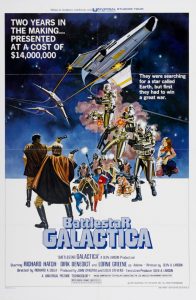
Battlestar Galactica 1978: An Overview

February 8, 2019 by David Dubrow 1 Comment

“There are those who believe that life here began out there: far across the universe, with tribes of humans who may have been the forefathers of the Egyptians, or the Toltecs, or the Mayans. Some believe there may yet be brothers of man who even now fight to survive…somewhere beyond the heavens.”

I was only in single digits when it was first broadcast, but I’ll never forget watching the original Battlestar Galactica television series. Most science fiction programs like Star Trek, The Invaders, and even My Favorite Martian were relegated to UHF back then. A high-budget network television show with dogfighting spaceships, scary robots, and aliens was special. Even the comic books were cool. We all wanted to be like Starbuck or Apollo. Adama was the wise grandfather we wish we had. And who didn’t want to pilot a Colonial Viper?

As I watch it today, Battlestar Galactica‘s flaws become more evident. It could be that it’s a different viewing experience when you’re not seated six inches from a wood-framed color TV, wide-eyed and absorbing uncounted roentgens of radiation. Or maybe it’s got real problems. Nevertheless, it’s still an entertaining program, and worth talking about. We can discuss the 2003 remake at a later time. I’ve got all the DVDs.

The most striking thing about the show when you first watch it is the music. Both sad and stirring, it fits perfectly within the theme of embattled humanity fleeing for its life across the blackness of space. It conveys both loss and dignity, grief and unbowed heads.

Casting and performances were uneven, but hit the mark where it counted. Lorne Greene inhabited Adama, and to those of us who never watched Greene in Bonanza (why would you when Star Trek reruns were on), he nevertheless became a favorite actor. A great leader of men. His rich, deep voice conveyed both wisdom and authority, and he was very rarely wrong about anything. You’d follow Adama to the end of the universe if he asked, and would be honored by the request every centon. Dirk Benedict as Starbuck was the perfect lovable rogue: smoked cigars, drank, played cards, joked, womanized, feared commitment but possessed fierce loyalty, always with an eye for the main chance. You rooted for him, or for Richard Hatch as Apollo, the strait-laced fighter pilot who always did the right thing, and did it by the book. The other characters were, for the most part, interchangeable except for Herbert Jefferson Jr as Boomer and John Colicos as the evil Count Baltar. No one else stood out.

The child character Boxey was a problem. His pet robot dog Muffit was a problem. Even as a small boy I hated them. Perhaps I was born a cynic, but back then I knew they’d only been put into the show to cater to young people like me. Perhaps if Muffit wasn’t so obviously a performer in a robot dog suit or if Boxey hadn’t been so irritating they might have been better received. As it was, they were an unwelcome distraction that took you out of the show.

There’s a fundamental decency to the characters, themes, and storytelling that’s completely absent from today’s television fare. The people of the 12 Colonies believed in God. They prayed to Him, these ancient, starfaring people who had a different Bible, a different set of legends and heroes. They had marriage and codes of honor and were appalled at the necessity, when all else failed, of putting their women on the front lines of combat in Colonial Vipers. The miniseries’s pilot, Saga of a Star World, reflects late 1970’s Cold War concerns, with the Cylons filling in for the Soviets as a dreadful, implacable enemy. This Cold War comparison becomes even more stark when Sire Uri, a leader among the surviving humans, suggests that they should dispose of all of their weapons to show the Cylons that humans are no longer a threat. The Cylons would presumably call off the war and sue for peace: a perfect metaphor for the demand for nuclear disarmament in the face of Soviet aggression. We know how that ended up in the real world, and the people of Battlestar Galactica were at least as wise as us in refusing Sire Uri’s suggestion.

The special effects were good for the time. A common complaint was the frequent reuse of certain special effects shots: dogfights, ships exploding, Vipers leaving the flight bay, etc. I already mentioned the unfortunate Muffit. Still, they don’t get in the way of the plot. The Cylons were creepy, with their absurdly shiny bodies and that red, endlessly scanning eye. Despite the uniformity of their electronic voices, they’re not emotionless robots: they experience anger, concern, and fear. Some even carry swords. There’s a Cylon culture buried somewhere deep in their reptilian past, but we don’t see much of it. Lucifer, Count Baltar’s erstwhile dogsbody, has a disquietingly effete, refined voice, but his sparkling robot head is too small for his body and he’s difficult to be afraid of. All in all, Battlestar Galactica‘s illusion is imperfect, but functional.

Unfortunately, the show had problems throughout its run, with high budgets, terrible mid-season episodes, and dwindling viewership. It didn’t last past a single season. Galactica 1980 failed to recapture the magic and didn’t last long, either.

Nevertheless, it still holds up. If barely.

“Fleeing from the Cylon tyranny, the last Battlestar, the Galactica, leads a ragtag fugitive fleet on a lonely quest: a shining planet known as Earth.”

Facebooktwitterredditpinterestlinkedinmail

Filed Under: Uncategorized Tagged With: 1978, battlestar galactica, science fiction, television review

Television Show Reviews, Part One

June 20, 2018 by David Dubrow 1 Comment

My recent illness found me incapable of doing anything but lying on the sofa (or a hospital bed) and suffering. It was worst in the early stages, when a non-stop headache made every waking moment a misery. I’m still not 100% now, and must spend part of the day reclining, but every day I thank God I’m not the me from a few weeks ago. That was awful.

So what do you do when you can’t do anything? You watch television, of course. In the last three weeks I’ve watched more television than I have in the last fifteen years. This is not a thing I’m proud of, but you do what you have to to get through. Pleasantly, there is more than enough TV available on Netflix to keep one occupied until Kingdom Come, more or less, so finding something to watch is never a problem.

What follows is a general rundown of the television shows I’ve binge-watched lately. Despite my illness, I watched them with a clear head and an eye for quality. There may be some minor spoilers here and there, but if you’re a grown-up, you can deal.

Black Mirror: Progressive millennials love this show. (I don’t look down on millennials like many Gen-Xers do; our military is filled to the brim with millennials and it’s the greatest fighting force on Earth.) It’s supposed to be a Twilight Zone-esque program focusing on technology running amok and its effects on society. Mostly science fiction with some horror and satire elements. Produced in the UK. Decent special effects, decent acting. It’s horrible. Unwatchable for anyone who isn’t stuck in a hospital bed. Imagine what scares your least-thoughtful progressive friend the most about something like social media, race relations, or surveillance cameras, and Black Mirror has made an episode about it. Every episode is predictable, tedious in its preachiness, and unbelievably dreary. This is what happens when the humorless, identity politics-obsessed social justice crowd makes TV for other humorless social justice warriors: a bland, pathetic, intelligence-insulting mess that gets by on intention over substance. Avoid at all costs. It’s possible that my recovery would be going faster if I hadn’t subjected myself to this waste of time.

Safe: After Black Mirror I wanted to watch something with some complexity. Safe, a suburban mystery-thriller, looked interesting: a murdered teen, a dad looking for his daughter, family secrets, some law enforcement intrigue (who doesn’t love that). Not only that, but I’d be treated to Michael C. Hall of Dexter fame aping an English accent the whole show. So it was a shoe-in. Overall, I liked it. Oh, the plot only moved forward because the characters made some inexplicable decisions, and Hall’s English accent was entirely unnecessary, but it was decent. Keeps you watching if you don’t want to think too deeply. If nothing else, watch it for Nigel Lindsay’s portrayal of Jojo, a wealthy, buffoonish business owner: he’s hysterically funny and steals every scene he’s in. They wisely use him in small bits, but he makes the role invaluable.

Fauda Season Two: You’ve seen season one, haven’t you? If not, you are in for a treat. It’s a show about the Israeli-Palestinian conflict that tells the story from both sides. The Palestinians are portrayed accurately: evil, amoral, and disgusting, but it’s fascinating to see them justify their atrocities and how they carry them out. The good guys, the Israelis, are depicted as being in the IDF’s Duvdevan Unit, a counter-terrorism force. (Several years ago I worked with Garrett Machine, a former Duvdevan Unit member, on an instructional video on Combat First Aid.) The show’s a fascinating look at the Middle East, at life in the Palestinian territories, and life in Israel. I highly recommend both seasons.

Altered Carbon: Sci-fi action. I couldn’t make it through the first episode. Nothing made sense, everyone behaved stupidly, and I didn’t care about anything that happened to anybody. James Purefoy couldn’t even save it.

More reviews in Part Two.

Facebooktwitterredditpinterestlinkedinmail

Filed Under: Uncategorized Tagged With: altered carbon, black mirror, fauda, me me me, safe, television review

  • 1
  • 2
  • Next Page »

"It began to drizzle rain and he turned on the windshield wipers; they made a great clatter like two idiots clapping in church." --Flannery O'Connor, Wise Blood

"Squop chicken? I never get enough to eat when I eat squop chicken. I told you that when we sat down. You gotta give me that. I told you when we sat down, I said frankly I said this is not my idea of a meal, squop chicken. I'm a big eater." --John O'Hara, BUtterfield 8

I saw the 1977 cartoon The Hobbit as a little boy, and it kindled a love of heroic fantasy that has never left me. Orson Bean's passing is terrible news. Rest in peace.

Obviously, these young people have been poorly served by their parents, but the honest search for practical information should be lauded, not contemned.

You shouldn't look at or use Twitter, and this story is another perfect example. There's so much that's wrong here that it would take a battalion of clergy, philosophers, and psychologists to fully map it out, let alone treat the issue.

This is the advertising copy for Ilana Glazer's stand-up comedy special The Planet Is Burning: "Ilana Glazer‘s debut standup special is trés lol, and turns out - she one funny b. Check out Ilana’s thoughts on partnership, being a successful stoner adult, Nazis, Diva Cups, and more. Hold on to your nuts cuz this hour proves how useless the patriarchy is. For Christ’s sake, The Planet Is Burning, and it’s time a short, queer, hairy New York Jew screams it in your face!" This is written to make you want to watch it.

In the midst of reading books about modern farming, the 6,000 year history of bread, and ancient grains, I found this just-published piece by farmer and scholar Victor Davis Hanson: Remembering the Farming Way.

"I then confront the decreasing power of the movement in order to demonstrate the need for increased theorizations of the reflexive capacities of institutionalized power structures to sustain oppositional education social movements." Yes. Of course.

You should definitely check out Atomickristin's sci-fi story Women in Fridges.

As it turns out, there may yet be some kind of personal cost for attempting to incite a social media mob into violence against a teenage boy you don't know, but decided to hate anyway because reasons.

One of the biggest problems with internet content is that the vast majority of sites don't pay their writers, and it shows in the lack of quality writing. It's hard to find decent writers, and harder to scrape up the cash to pay them. This piece is a shining example of the problem of free content: it's worth what you pay for.

If you're interested in understanding our current cultural insanity, the best primer available is Douglas Murray's The Madness of Crowds. Thoughtful, entertaining, and incisive.

More laws are dumb. More law enforcement is dumb. The only proper response to violence is overwhelming violence. End the assault. There's a rising anti-semitism problem in New York because Jews who act like victims are being victimized by predators. None of these attacks are random. Carry a weapon and practice deploying it under duress. Be alert and aware. I don't understand why the women Tiffany Harris attacked didn't flatten her face into the pavement, but once word gets around that the consequences of violence are grave, the violence will lessen.

When are you assholes going to understand that this stupidity doesn't work any longer? Nobody gives much of a damn if you think we're sexist because we don't want to see a movie you think we should see. It only makes us dislike you that much more, and you started out being an unlikable asshole. Find a new way to shame normal people.

The movie Terms of Endearment still holds up more than 35 years later, and if you're looking for a tearjerker, this is your jam. One element that didn't get a lot of mention is, at the end, when Flap, with a shrug, decides that his mother-in-law will become the mother of his children once Emma dies. He abandons them, and nothing is made of it. This always troubled me.

You need to read this story the next time you feel the urge to complain. And if you need a shot of admiration for another family's courage, check this out.

Progressive political activist and children's author J.K. Rowling finds herself on the wrong side of a mob she helped to create. The Woke Sandwich she's been trying to force-feed others since she earned enough f-you money doesn't taste as good as it looks when she's obliged to take a bite.

I need you to check out The Kohen Chronicles and pray for this family. Their 5-year-old son has cancer.

Currently, the movie Star Wars: The Rise of Skywalker stands at 55% at Rotten Tomatoes. Don't forget that these are the same reviewers who not only adored the absolutely execrable The Last Jedi, but insisted that you were a MAGA hat-wearing incel white supremacist manbaby for not loving The Last Jedi. So either The Rise of Skywalker is an objectively bad film, or it simply wasn't woke enough to earn plaudits from our movie-reviewing moral and intellectual betters.

It's easy to hate the older pop bands like Genesis for their popularity, but they were capable of genius, and it shows in No Son of Mine.

If you want to know which identity group has more clout, read this story of the Zola ads on the Hallmark Channel.

Rest in peace, René Auberjonois. I remember you from Benson as a kid. As an adult, I remember you as Janos Audron in the Legacy of Kain video game series. You made every role you were in a classic.

Elf on a Shelf Follies, Part 2:
8-year-old: I wrote the elf a note! I hope he writes back.
Me: What did you write?
8yo: I asked if he has any friends.
Me: What if he says it's none of your business?
8yo: *eyes grow dark and glittering* Then I'll...touch him.
Me: Ah. Mutually assured destruction, then.

Elf on a Shelf Follies, Part 1: My 8-year-old got an Elf on the Shelf the other day. The book it came with tells a story in doggerel about this elf's purpose, which is to spy on the kid and report his doings to Santa Claus, who would then determine if the kid is worthy for Christmas presents this year. The book also said for the kid not to touch him, or the magic would fade, and for the family to give the elf a name. I wanted to name him Stasi. I was outvoted.

Actor Billy Dee Williams calls himself a man or a woman, depending on whim; his character Lando Calrissian is "pansexual," and his writer implies that he'd become intimate with anyone or anything, including, one presumes, a dog, a toaster, or a baby. J.J. Abrams is very concerned about LGBTQ representation in the Star Wars universe. This is Hollywood. This is Star Wars. This is what's important to the people in charge of your cinematic entertainment. Are you not entertained?

The funniest thing on the internet today is the number of people angry over an exercise bike commercial. Public outrage is always funny. Always.

One of the biggest mistakes the United States has ever made since WWII was recruiting for clandestine and federal law enforcement organizations at Ivy League schools. The best talent pools were/are available from local law enforcement and military veterans, with their maturity and, most importantly, field experience. We've been reaping the costs of these terrible decisions for decades, culminating in a hopelessly politicized, sub-competent FBI and CIA.

Watching Fauda seasons 1 and 2 again in preparation for season 3 to be broadcast, one hopes, in early 2020. Here's my back-of-the-matchbook review of season 2.

Every day I try to be grateful for what I have, even in the face of the petty frustrations and troubles that pockmark a day spent outside of one's living room, binge-watching Netflix. We live lives of ease in 21st century America, making it enormously difficult to do anything but take one's countless blessings for granted. Holidays like the just-passed Thanksgiving are helpful reminders. There's a reason why people call the attitude of a thankful heart practicing gratitude, not just feeling grateful. You have to practice it. You have to remind yourself of what you have. It's the work of a lifetime.

Held Back: A Recent Conversation.
8-year-old: Oh, and Jamie was there, too. He was in my first grade class two years ago.
Me: Wasn't he held back a year?
8yo: Yeah. It's because he kept going to the bathroom with the door open.
Me: No way!
8yo: And girls saw.
Me: That's not right. They're not going to hold a kid back a whole year over that.
8yo: Well, that's what he told me.
Me: Sounds fishy.
8yo: I believe him.
~fin~

It's right and good to push a raft of politically correct social justice policies on everything else under the sun, but when social justice invades Hollywood, that's just a bridge too far, says Terry Gilliam. Sorry, Terry: you helped make this sandwich. EAT IT.

Rob Henderson's piece on luxury beliefs will have you nodding your head over and over again...unless you subscribe to these luxury beliefs, in which case you'll get mad.

I've made the Saturday bread from Flour Water Salt Yeast so often that I've memorized the recipe. It never disappoints. Never. The same recipe works well for pizza, too.

Liberty doesn't mean the freedom to do anything you want. The true definition of liberty is the ability to choose the good. Anything less is libertinism.

Archives

My Social Media Links

  • Twitter
  • Facebook
  • Google +

Author Links

  • Amazon Author Page
  • Goodreads

Copyright © 2026 · Author Pro Theme on Genesis Framework · WordPress · Log in