I spent part of last week and the weekend up north visiting family. Travel, especially with a small child, can be exhausting, so Sunday night after my son went to bed and we were able to relax for a bit, I thought to check how the Get the Greek Hanukkah giveaway did.
New Kindle Single Now Available!
My short story Get the Greek is now available as a Kindle Single in the Amazon bookstore!
To paraphrase the great Mark Twain, “Everyone talks about the commercialization of the holiday season, but nobody does anything about it!”
Had this story been written by populist television personality Bill O’Reilly, it would have been titled Killing Santa. My publisher wanted to title it When Judah Met Santa (though in her Boston accent it came out like “When Juder Met Santer”), but I nixed it because this isn’t a love story. It’s a short, comic tale about Hanukkah, Christmas, and the lengths one historical figure might go to end the commercialization of the holiday season.
Actually, it’s got a few historical figures in there. Plus an angel. And Santa Claus. It all works, believe me.
Get your copy for $0.99 while they’re still so cheap!
A Horror Cliché to Be Eliminated
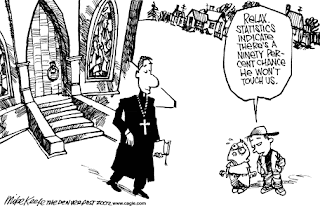
Inspired by this excellent article by Kayleigh Marie Edwards, I will discuss a cliché that I would like to see go by the wayside, as it’s become such a tiresome theme in not just horror, but genre fiction in general: the cliché of the Hypocritical Christian.
For reasons that go beyond the scope of this piece, modern culture has elevated hypocrisy to the unofficial Eighth Deadly Sin, despite how common it is. We are all hypocrites in some fashion or other, but when it comes to religious hypocrisy, where the sinner has the guff to quote Scripture to explain the basis of his beliefs, that’s somehow a bridge too far. This has an element of gotcha in it, as the rulebook for Christians is so widely available: the Bible. It’s easy to point out sections of the Bible that aren’t followed and demand that the offending Christian follow them or be damned as a hypocrite. That this all-or-nothing approach is never required anywhere else in modern life is immaterial: the accusation is what counts. Religious hypocrites are, to some, particularly galling, and must be denounced. Especially in fiction. More especially in horror fiction. Even two of horror’s most famous authors have indulged in it: Clive Barker and Stephen King.
I’ve mentioned this at length in my review of Clive Barker’s The Scarlet Gospels: “If there is one central theme running throughout The Scarlet Gospels, it’s explicitly anti-Christian. Every time Christianity is mentioned, it’s linked to hypocrisy, abuse, and evil. Carston Goode, the ghost who brought both Norma and D’amour into the events of the story, was one such hypocrite. Despite ‘a deep-seated faith in the generosity of the Lord his God,’ Goode is a sorcerer with a secret life of sexual deviance.”
In Stephen King’s Carrie, The Mist, and The Shawshank Redemption, the greatest (human) antagonists often quoted the Bible as a motivating factor in their menace.
Films like The Last Exorcism also carry this theme forward; indeed, it’s difficult to find a positive representation of Christianity in contemporary horror movies at all, and you’ll have to go back to the 1970’s and 1980’s to find examples. In The Exorcist, Father Karras sacrifices himself to save the possessed Regan, and in Omen 3: The Final Conflict, we see a vision of Jesus Christ at the end, when Damien is sent back to Hell. It’s a safe bet that if there’s a pastor in a horror movie made within the last thirty years, he’ll be a bumbling incompetent at best, or if he’s wearing a black cassock and white collar, a sexual deviant.
There are occasional exceptions, of course: From Dusk Till Dawn‘s Jacob Fuller, for example (note that this movie is almost twenty years old). Graham Hess in 2002’s Signs. The Rite. Nevertheless, Christianity has been used as a punching bag for writers either looking to plant an ideological flag or are too lazy to find a more interesting antagonist. For the sake of that ever-elusive originality, if nothing else, it’s time to put this cliché to rest.
It’s no longer daring or trendy or cutting edge to see a sinning priest. The pendulum’s swung so far that way that it’s rare to see, in genre fiction, a priest who isn’t a criminal or idiot or hypocrite.
God’s Not Dead: You Deserve Better
We need to talk about God’s Not Dead. It’s available on Netflix streaming.
Horror fans are a lot like Christian fiction fans: there are so many truly terrible horror movies out there that when one comes out that’s even half-good, it gets lauded by fans of the genre as a masterful piece of filmmaking and praised way beyond its quality. Horror and Christian films are difficult genres to get right, but when they’re done properly, they can be extraordinary.
God’s Not Dead was not done properly. It’s a terrible movie. I can’t believe that anyone who liked it can say how great it was without including some pretty massive caveats. You shouldn’t do that. Don’t make excuses for bad art. Despite how bad it is, it made, according to IMDB, a staggering $60,753,735. That’s a lot of money for such a bad film.
I understand that the film’s intent is not to convert the non-believer, but to preach to the converted. That’s perfectly fine. As a Jew, I’m not the intended audience. Nevertheless, I came in wanting to like the movie, not to poke holes in it or express derision for its explicitly religious themes. I like Christian fiction, even though I belong to a different faith.
The most glaring problem with the movie was its utter lack of subtlety in every aspect. None of the characters had any depth to speak of, and none of the situations portrayed were at all believable. Our willing suspension of disbelief works for horror movies and superhero flicks because we go to the theater expecting unbelievable things. God’s Not Dead isn’t a science fiction movie: it’s a film about Christian apologetics, and requires a certain amount of realism to successfully carry its theme. The film was entirely unrealistic because almost every single character in it was a caricature, not an actual person. This is extremely problematic in a character-driven story like God’s Not Dead.
Radisson, the antagonist, was awful in every particular you can imagine: he belittles his girlfriend in public and in private, insults anyone who disagrees with him, and even threatens the protagonist Josh with flunking out of school. He’s not just an atheist, but an anti-theist. He literally hates God. Why? Because his religious mother died of cancer when Radisson was twelve. It’s a popular belief that under the skin of every atheist is a living, breathing Christian once tragically disappointed by the apparent capriciousness of God. But there’s no difference between that belief and the thinking that people who dislike homosexual behavior do so because they are themselves gay and fight against their hated urges through gay-bashing. Neither of these beliefs is accurate. They’re childish. Some people just don’t believe in God. Radisson’s deathbed conversion (well, deathstreet conversion) was not just unsubtle, but insulting. None of Josh’s arguments were persuasive enough to plant even the smallest seed of doubt in Radisson’s mind. It simply took the fear of an eternity in Hell to get him to accept Jesus Christ. Doesn’t that undercut the entire intellectual basis for becoming a Christian? The screenwriters had the nerve to use this quote from C.S. Lewis: “Only a real risk tests the reality of a belief,” but entirely forgot Lewis’s own conversion to Christianity: “When we set out I did not believe that Jesus is the Son of God and when we reached the zoo I did.” Sometimes, even a lot of times, that’s what it takes: careful consideration over time. Subtle changes leading to acceptance. It shouldn’t take hitting people with cars to get them to see your point of view.
Amy Ryan’s story was a carbon copy of Radisson’s in theme if not circumstance. She begins as a ludicrous caricature of a leftist journalist, asking questions no real reporter ever asks (even on MSNBC), and finally begins to see the light of Christ when she’s diagnosed with terminal cancer. We can only sympathize with her because she’s going to die of cancer, not because she’s nice or displays admirable qualities of any kind. Also, the Duck Dynasty stars’ cameos were, let’s face it, included to add dubious (and now waning) star power, not because they added value to the plot or characterization. Christian apologetics, as a philosophy, is deeper than the “no atheists in foxholes” argument, but we get little else in its practical application in Amy and Radisson’s stories.
Marc the businessman was laughably evil: he broke up with Amy because she had cancer, and was later called the Devil by his own ailing mother. Josh’s girlfriend Kara was the typical unsupportive, controlling female Josh had to get rid of to complete his task (the actress’s performance of her was horribly wooden). Ayisha the Muslim got thrown out of the house because she just couldn’t conceal her love of Jesus from her mute younger brother, but without buildup or conclusion, her story seemed out of place, unfinished. Reverend Dave’s story was kind of nice, if clumsily written.
For the most part, the performances were fine. Kevin Sorbo was the stand-out, obviously relishing his role as antagonist. Shane Harper did okay, though his face could only make three expressions throughout the film. They didn’t give Dean Cain very much to do. I’d last seen David A.R. White in Six: The Mark Unleashed, so it was nice to see him in this role. Benjamin Oyango had the best lines, and did the best with them (the accent helped).
Obviously, if all you want to do is reinforce faith, then you don’t have to work as hard as you would to convert a non-believer. But don’t you deserve better than this ham-handed effort? It could more easily have been made into a blog post pointing to great Christian philosophers like Blaise Pascal, C.S. Lewis, and William Lane Craig. Heck, Dinesh D’Souza made a documentary called America. Why not a well-produced documentary on Christian apologetics? You don’t need Duck Dynasty for that.
If you saw it and liked it, great. You deserve better, though. You deserve something with depth. Don’t subsidize bad movies because there’s nothing else out there. Demand quality.
Movie Review: Noah
Noah was an entertaining film that had a nodding acquaintance with the source material, some decent performances, and a lack of narrative focus that turned it into a mess. It’s not boring, but it’s not particularly good, either. The more interesting elements were overshadowed by the thematic chaos: Aronofsky wanted to do a Biblical picture, but he wanted to give it a modern sensibility. The result was an attractive, disappointing failure.
- Green Day: It’s obvious that Aronofsky’s intent all along was to shoehorn environmentalism into a setting that had no place for it: the antediluvian Earth. The Biblical version of Noah explicitly states that the whole of humanity was bent toward sin: “God saw that the people on earth were very wicked, that all the imaginings of their hearts were always of evil only. (Genesis 6:5)” That won’t do in Hollywood. Making judgments about other people’s behavior or mores is Simply Not Done unless those mores conflict with standard Hollywood groupthink. So Aronofsky had to come up with a real sin: pollution. Strip-mining. Deforestation. That’s what would make God mad enough to drown the world. It’s ludicrous.
- He’s a Beauty: Ray Winstone did a great job as Tubal-cain, the main human antagonist. Brutal, thoughtful, manipulative, and entirely useless to the story. There was no reason to have him in the film. He did nothing to advance the plot, change the circumstances, or affect the outcome. He had the best lines, but there wasn’t any need for them or him. The silliest part was him stowing away on the Ark and sitting in the hold, hidden by Noah’s son Ham, for months without anyone knowing. At least we know what happened to the unicorns and gryphons and dinosaurs: Tubal-cain ate ’em on the long voyage.
- Somebody’s Watchin’ Me: The Watcher angels were extremely cool, but too reminiscent of stony Ents. According to the Bible, the Watchers were the angels who descended to Earth to sleep with human women. The offspring of these unions were the Nephilim, half-angel, half-human hybrids who were said to be giants: “There were giants on the earth in those days; and also after that, when the sons of God came in unto the daughters of men and they bore children to them, the same became mighty men who were of old, men of renown. (Genesis 6:4)” Because Aronofsky had to change the reason for God’s anger at humanity from sin to environmental disaster, the Watchers couldn’t be human-like enough to father Nephilim: they had to be monsters. Interestingly, Aronofsky did mine the Book of Enoch for the narrative that the Watchers taught men metalworking and other skills, which added depth.
- Noah’s Crazy Train: Aronofsky undercuts his own environmental schtick by having Noah turn into a cross between Paul Ehrlich and Charles Manson in the second half of the film. His extremism, self-loathing and hatred for humanity weren’t hinted at in the early stages to make his later insanity anything but jarring and out of place. It’s unbelievable to me that his family would, over the course of several months, accept his insistence that if Shem’s wife bore a girl, he’d kill the baby right there and then. They should have thrown him overboard as soon as they could, because he was clearly insane.
- H.A.M.: While I understand that to build tension in a story that everyone knows the outcome of, you have to create other conflicts, having Ham’s lack of female companionship be such a sticking point seemed clumsy, even absurd. Once again, Aronofsky had to go outside of the source material to create tension, which was unnecessary: there was already some weirdness going on in the Ark. “And they made their father drink wine that night, and the firstborn went in and lay with her father; and he perceived not when she lay down, nor when she arose. (Genesis 19:33)” Why not look at that for conflict? It certainly was…strange. Did they just have cabin fever?
- Methusaleh as Gandalf: There are magic rocks in the antediluvian world called Zohar, according to Aronofsky, which produce pyrotechnic effects not unlike the light crystals in Land of the Lost. This was also silly and unnecessary. What made things worse was the presence of Methusaleh, who had undefined sorcerous abilities that made him seem more like Gandalf than a servant of the Creator. He didn’t need to be there, or if he did, he should have had a stronger role. As it was, Anthony Hopkins did the best he could with him, but the character just wasn’t written well.
I entirely understand those who take offense to Aronofsky’s altering of Scripture to advance a secular agenda in this film, but for me, the true offense was that the movie wasn’t that good. It looked good. The people in it acted well. But for the most part, it was a silly, overproduced mess. I’m not sure if it’s worth watching just to see how much Aronofsky hosed the Biblical story of Noah, but if you want a fantasy film about people and water and animals, then it wasn’t half-bad. Three out of five stars.
The Prophecy’s Angels as Immature, Brutal Childen
Gregory Widen’s The Prophecy is an extraordinary, imaginative film that shows angels in a much different light from the celestial beings humanized by television shows like Touched by an Angel and articles in Reader’s Digest. Widen’s angels are brutal, savage, animalistic. Rather than create an angel mythology out of whole cloth, Widen mined the Bible for angelic references to show us that angels are, in their hearts, killers.
This central theme is stated quite clearly when Thomas Daggett, the protagonist, says, “Did you ever notice how in the Bible, whenever God needed to punish someone, or make an example, or whenever God needed a killing, he sent an angel? Did you ever wonder what a creature like that must be like? A whole existence spent praising your God, but always with one wing dipped in blood. Would you ever really want to see an angel?”
Physically, Widen’s angels display birdlike behavior, given that their true forms are winged, eyeless humanoids. They perch like raptors, a bizarre affectation that works very well in the film. Uziel, Gabriel’s lieutenant, scents for the angel Simon like an animal would, and their subsequent fight is extremely brutal, without human finesse or mercy. After stabbing Simon, Uziel literally digs into the wound, trying to pull out his heart.
Uziel’s autopsy scene further shows how separate the angels are from humans, from the lack of growth rings on their bones to the bizarre makeup of their blood (chemicals usually only found in an aborted fetus). Hermaphroditic, lacking eyes, they’re just different.
Later, we see the Archangel Gabriel literally tasting the shed blood on the wardrobe after Uziel and Simon’s fight, able from this to determine that it came from Simon. Not even a higher order of angel like Gabriel is exempt from this kind of base animalism. They’re not beautiful, celestial messengers of God, but are, in Daggett’s terms, “creatures.”
In addition to their bestial nature, the angels in The Prophecy are bizarrely childlike in both temper and behavior. The entire conceit of the film, that certain angels became jealous of humans for being created with souls and acquiring God’s chief affection, is essentially a gigantic, millennia-long temper tantrum. A war, with casualties and spiritual consequences that affect the spiritual future of the human race, based entirely on envy.
This is shown most clearly in Gabriel, arguably one of Christopher Walken’s greatest roles. He contemptuously refers to humans by the juvenile term “talking monkeys,” but can’t even drive a car, showing an immature helplessness. During his confrontation with Simon, Simon tells him, “Sometimes you just have to do what you’re told,” which is very reminiscent of a parent scolding a child. When Simon won’t tell Gabriel where he’d hidden Hawthorne’s soul even after being tortured, Gabriel stamps his foot and shouts in a childish fit of pique: a mini-tantrum.
Perhaps the best indication that the angels are emotional children, bereft of a father as a result of their ruinous war in Heaven, is when Gabriel tries to entice Thomas to fight alongside him: “Nobody tells you when to go to bed. You eat all the ice cream you want. You get to kill all day, all night, just like an angel!” Gabriel’s speaking ironically about the bed time and ice cream, but the language he uses still evokes images of childlike freedom. Despite his contempt for humans, he is himself beneath them in maturity and ethics.
And what of God in this war-torn universe? The only time we hear of Him is when Daggett asks Gabriel, “If you wanted to prove your side was right, Gabriel, so badly, why don’t you just ask Him? Why don’t you just ask God?”
Gabriel’s answer is poignant, and in many painful ways puts him on the same level as us: “Because He doesn’t talk to me anymore.”